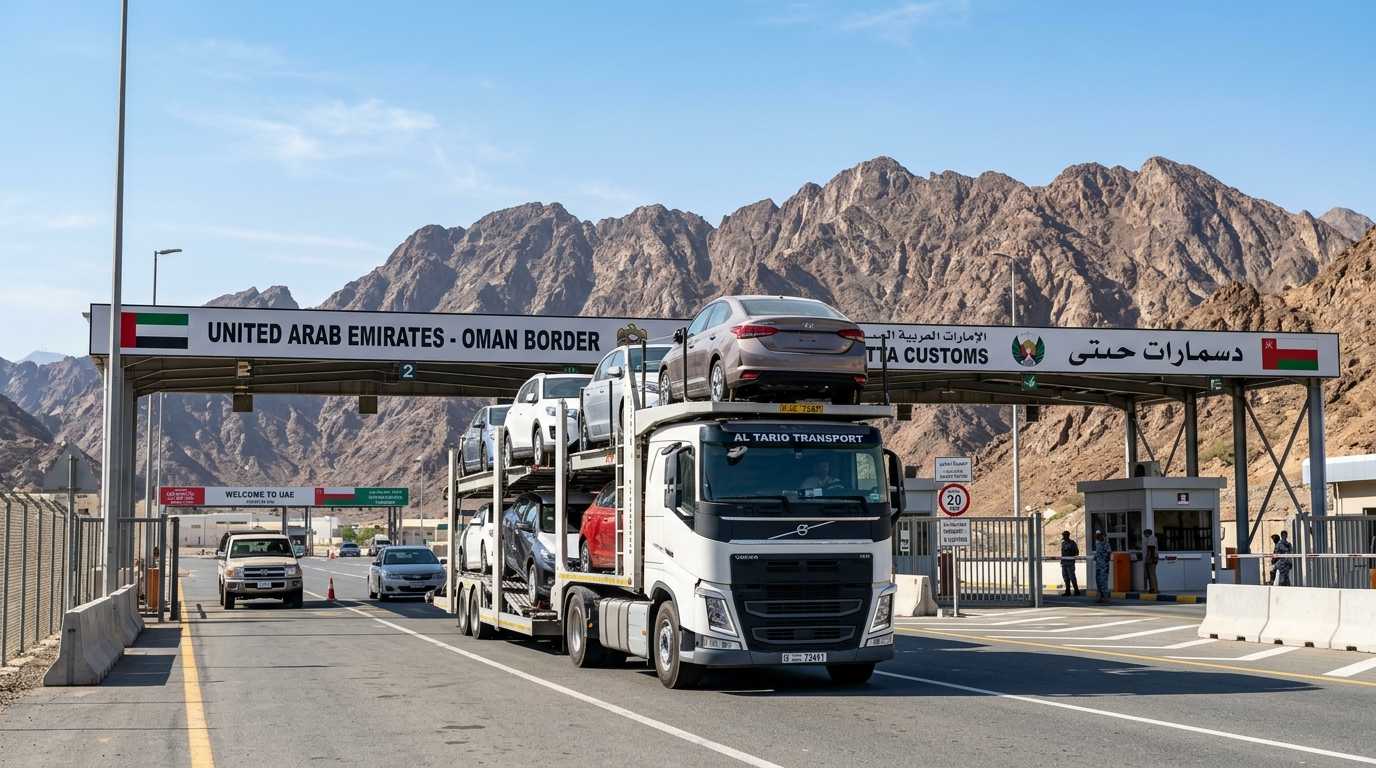
Car Shipping from UAE to Oman – What the Hatta Border Crossing Actually Looks Like
Oman is the easiest GCC destination for car shipping from Dubai. No Saudi transit, no complex multi-country coordination. Just a direct road crossing through Hatta or Al Ain and you’re in Oman. The whole process is shorter and simpler than any other GCC vehicle shipment from the UAE. But there are still specific requirements from RTA, UAE Customs, and Oman Royal Customs that you must get right.
Here’s exactly how it works, from the Dubai side to delivery in Muscat or wherever else in Oman the car needs to go.
The Two Main Border Crossings for UAE to Oman
Hatta Border Crossing
The Hatta crossing is the most direct route from Dubai to Muscat. You go through Hatta, pass through a small strip of Oman territory (the Madha exclave), re-enter UAE briefly in the Fujairah area, then cross into Oman proper through the Khatmat Malaha or Wajajah crossing. This route serves northern Oman destinations including Muscat, Sohar, and Nizwa. Car carriers use this route regularly and it’s well-serviced. Total driving time from Dubai to Muscat via Hatta is approximately 4 to 5 hours under normal conditions.
Al Ain Crossing (Mezyad / Buraimi)
The Al Ain to Buraimi crossing is another option, serving Oman’s Al Batinah region and the interior. It’s useful for vehicles going to Sohar or the Buraimi Governorate. Transit time from Dubai via Al Ain to Muscat is slightly longer — approximately 5 to 6 hours — but this route avoids the narrow Hatta mountain roads that some large car carriers prefer to skip.
Required Documents for Car Shipping UAE to Oman
| Document | Issuing Authority | Critical Detail |
|---|---|---|
| Vehicle Registration (Mulkiya) | UAE RTA | Must be valid; export deregistration required |
| RTA Export Plate | Dubai/Abu Dhabi RTA | Issued after deregistration; surrendered at Oman border |
| UAE Export Customs Declaration | UAE Customs via forwarder | Filed electronically via Mirsal 2 |
| Bank NOC | UAE financing bank | Required if vehicle has outstanding finance |
| Oman Import Declaration | Royal Oman Police via customs agent | Arranged by Oman-licensed agent |
| Vehicle Inspection Certificate | Authorised inspection centre UAE | Some Oman customs posts require pre-inspection |
UAE RTA Deregistration – Do This First
Before a vehicle can legally leave the UAE for Oman, the Dubai RTA or relevant emirate’s transport authority must issue an export plate and deregistration certificate. This process takes one to two working days. You clear any outstanding vehicle fines, cancel the UAE insurance, surrender the Salik tag if applicable, and get the export plate. The export plate goes on the car for the crossing and is surrendered to Oman customs at the border. This step is not optional. UAE Customs at the border crossing will not clear a car that has an active registration without an export plate.
What Happens at the Hatta Border Crossing
UAE Customs Exit
At the UAE exit point, the customs officer checks the export declaration filed by your forwarder through Mirsal 2. They verify the chassis number on the vehicle matches the declaration. If everything matches, the vehicle is cleared for exit. The export plate is photographed and recorded. The whole process for a properly documented vehicle typically takes 30 to 60 minutes at the UAE side.
Oman Customs Entry
On the Oman side, Royal Oman Police Customs processes the import. They check the vehicle against the import declaration filed by your Oman agent, inspect the chassis number, and assess the import duty. Oman charges customs duty on imported vehicles based on the vehicle’s CIF value (Cost, Insurance, Freight). The rate is typically 5% for GCC origin vehicles under the GCC Common Customs Law, though specific rates depend on the vehicle type and any applicable exemptions. After duty payment or guarantee, the vehicle is cleared.
A Real Experience at the Hatta Crossing
A client in Dubai Silicon Oasis shipped his Nissan Patrol to Muscat where his family had relocated. The car had a minor outstanding fine from a Salik error that wasn’t showing in the usual fine-checking system. When we ran the final check at RTA before deregistration, the fine appeared. It was AED 200. Small amount, massive consequence — RTA would not issue the export plate until it was paid. The client was flying to Muscat the next morning. We sorted the fine payment online and resubmitted. RTA issued the export plate the same day. The car crossed Hatta the following morning and arrived in Muscat before the client’s flight landed.
Check every single fine before you go to RTA. Not just the big ones. Even AED 50 will stop your deregistration.
Oman Customs Duty and Registration After Import
- Oman customs duty is typically 5% of the vehicle’s CIF value for GCC-origin vehicles
- After customs clearance, the vehicle must pass the Royal Oman Police vehicle inspection (Takhlis)
- The Takhlis inspection checks roadworthiness, lighting, brakes, and emissions
- After passing Takhlis, the owner registers the vehicle at the nearest Royal Oman Police traffic department
- A new Omani registration card (Mulkiya) and plates are issued
- UAE export plates must be surrendered to Oman customs and cannot be driven on in Oman
How Long Does Car Shipping from UAE to Oman Take
The actual road transit from Dubai to Muscat by carrier is 5 to 7 hours including the border crossings under normal conditions. However, the total process from when you start paperwork to when the car is registered in Oman and ready to use takes longer. Allow 3 to 5 days total: 1 to 2 days for UAE deregistration (plus bank NOC time if needed), 1 day for transit, and 1 to 2 days for Oman customs clearance and Takhlis. If everything is prepared in advance, the car can be in Muscat and cleared within 48 hours of starting the UAE process.
Special Considerations for Temporary Vehicle Import to Oman
If you’re not permanently relocating but just taking your car to Oman for a period, Oman allows temporary vehicle import under the GCC tourist vehicle rules. UAE residents can drive their UAE-registered cars into Oman temporarily without deregistering, subject to a valid UAE insurance policy that covers Oman. Temporary import is limited to a specific period and is for visiting, not for permanent residence. If you’re permanently moving to Oman or selling the car there, full import with deregistration and customs clearance is required.
Our team at cargo services in Dubai handles vehicle shipping from UAE to all Oman destinations — Muscat, Sohar, Salalah, Nizwa, and more. We coordinate with our Oman agents for seamless customs clearance on your behalf.
Learn more about our full vehicle and cargo services at car shipping to Oman from UAE.
Frequently Asked Questions
Can I drive my UAE car to Oman without shipping it on a carrier?
UAE residents can drive personally into Oman for tourism with their UAE registration, subject to having valid insurance covering Oman and meeting GCC cross-border vehicle rules. But for permanent relocation or selling the car in Oman, you must go through the full export-import process including deregistration. Driving a UAE car permanently in Oman without proper import clearance is not permitted and risks confiscation by Oman authorities.
How much does car shipping from Dubai to Muscat cost?
Car shipping rates from Dubai to Muscat depend on vehicle size, type, and current carrier availability. Open carrier transport is more affordable than enclosed carrier. The rate covers pickup, carrier loading, UAE export documentation, border crossing, and Muscat delivery. Oman customs duty and Takhlis inspection fees are separate. Request a fully itemised quote so you understand what is and isn’t included in the base price.
What is the Takhlis inspection in Oman?
Takhlis is the Royal Oman Police vehicle roadworthiness inspection required before a newly imported vehicle can be registered in Oman. The inspection checks brakes, lights, tyres, emissions, and the vehicle’s general condition. Most vehicles in good mechanical condition pass without issues. The inspection is done at a designated Royal Oman Police inspection centre. Vehicles that fail Takhlis must be repaired before they can be registered and used legally in Oman.
Does my UAE car insurance cover Oman?
Some UAE vehicle insurance policies include GCC coverage that extends to Oman. Check your policy documentation or call your insurer to confirm. If your policy doesn’t cover Oman, you need either an extension from your UAE insurer or a separate Oman third-party insurance policy. Once you permanently import and register the car in Oman, UAE insurance is no longer applicable and you need a new Omani insurance policy.
How long is the Hatta border crossing process?
For a well-documented vehicle with all paperwork in order, the Hatta crossing process typically takes 1 to 2 hours total across both UAE and Oman sides. During peak times such as weekends, UAE public holidays, or Ramadan travel periods, wait times can extend to 3 to 4 hours. Your carrier company will advise on the best time of day to cross based on current traffic and crossing conditions.
As you settle into your new surroundings in Oman after your move, consider exploring relaxation options to help ease the transition, such as understanding the benefits of various therapies, including those found in a quality massage experience.