The Cinematographer’s Protocol: How to Choose a Moving Company for Video Equipment
Listen up. I’m a Director of Photography. I own an ARRI Alexa 35, a set of vintage Cooke anamorphic lenses, and a high-speed Phantom camera. This kit is worth 500,000 Dirhams. More importantly, it’s my livelihood. When a production manager tells me they are going to hire a “regular camera mover” to relocate my gear to a new studio in Al Quoz, I physically lock my cases. Video equipment is not consumer electronics. It is a collection of hyper-sensitive sensors, precision glass, and delicate mechanical alignments that cannot handle a single G-force shock or a single degree of temperature spike. If you don’t choose a moving company for video equipment that understands ‘Flight Case’ physics and sensor-safety protocols, you are one kinetic shock away from a total equipment loss. You cannot move a cinema kit like you move a TV.
Last year, a local production house moved their kit. They hired a standard mover who stacked the lens cases on top of each other without strapping them down. During the truck journey, the truck hit a series of speed bumps near Dubai Production City. The vibration was so intense that the internal glass elements of a 50,000-Dollar Master Prime lens shifted by a fraction of a millimeter. The lens was ‘soft’ for the next shoot, ruining a 100,000-Dollar commercial project. Total professional catastrophe.
You have to be paranoid. Let me show you the DP’s protocol for safe cinematic transit.
The Kinetic and Vibration Mandate
G-force is the silent killer of a 4K sensor.
The ‘Flight Case’ and Foam Protocol
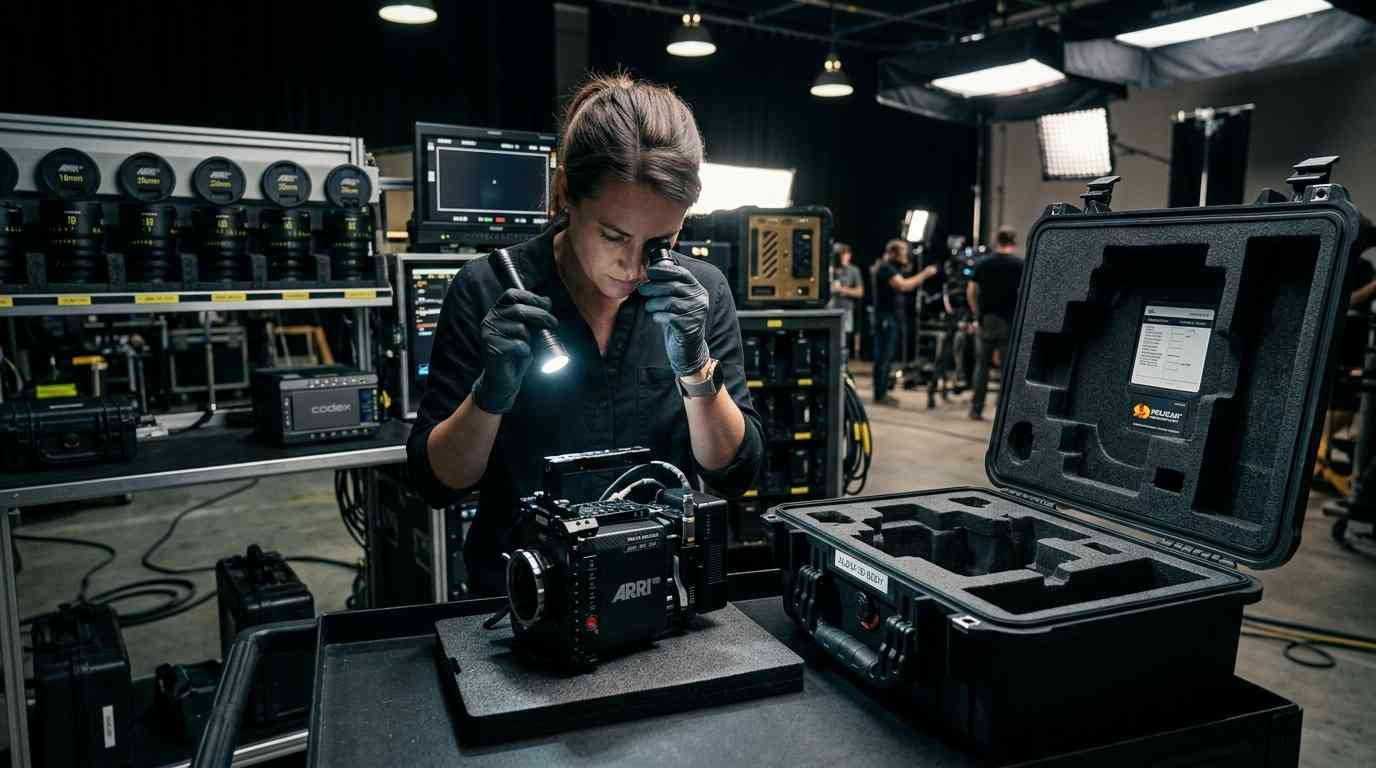
Never move a camera body or a lens outside of a custom-cut, hard-shell ‘Pelican’ or ‘Flight Case.’ But here is the secret: the foam must be high-density ‘Plastazote.’ Standard cheap foam will disintegrate and leave ‘dust’ on your sensor. Every case must be individually strapped into a truck with air-ride suspension. If your mover tries to stack cases without using cargo nets or load-bars, stop them. They are about to turn your lenses into expensive kaleidoscopes.
The Atmospheric Threat: Humidity and Fungus
Dubai’s humidity is a slow-acting poison for precision optics.
The Desiccant and Climate-Control Strategy
Precision lenses are organic—the lubricants inside them can thin out in the Dubai heat, and the humidity can trigger ‘lens fungus’ that eats away at the coatings. Every lens case must have a fresh, industrial-grade silica gel canister. Furthermore, the transit must be done in a temperature-controlled (chilled) truck. If the equipment reaches 40 degrees, the electronics in the camera brain can begin to fail, and the grease in the lens focus-mechanisms will migrate onto the aperture blades. Your gear stays at a constant 22 degrees. No excuses.
If you are relocating a professional studio, a rental house, or an independent DP’s kit and need a team that understands the paranoia of moving high-value cinematic assets, check out our Services and specialized media relocation division. We are the best movers and packers in UAE because my crew knows that a scratch on a lens is a scratch on your career.
The Security and Audit Reality
High-end camera gear is the most portable, high-value asset in the media world.
The Serial Number Manifest
Before the move, you must create a digital manifest with high-resolution photos of every serial number and every sensor-port. This isn’t just for insurance; it’s to prevent ‘switching.’ Moving insurance for ‘household goods’ is based on weight—meaning they will offer you 10 Dirhams for an ARRI camera worth 250,000. You must have a ‘Media & Production’ insurance rider that covers the full ‘New Replacement Value’ of the gear during transit. If the mover doesn’t have their own professional liability insurance that covers media assets, do not let them touch the cases.
Essential Video Equipment Moving Checklist
| Technical Requirement | Why It Prevents a Professional Disaster |
|---|---|
| Hard-Shell Flight Cases Only | The only way to protect delicate camera brains and lenses from kinetic shocks. |
| High-Density Plastazote Foam | Ensures the gear doesn’t move inside the case and prevents ‘foam-dust’ contamination. |
| Air-Ride Suspension Transit | Protects mechanical lens alignments from the vibration of Dubai’s roads. |
| Climate-Controlled (Chilled) Truck | Prevents lens lubricant migration and electronic failure in the Dubai heat. |
| Serial Number & Sensor Audit | Provides a legal trail for insurance and ensures the gear arrives in working order. |
Frequently Asked Questions
Should I move my cameras with the batteries attached?
Never. Large V-Mount or Gold-Mount batteries are lithium-ion and are considered hazardous cargo. They must be removed from the camera bodies and moved in specialized fire-proof ‘Lipo-Bags.’ If a battery malfunctions in a moving truck, it can start a chemical fire that is impossible to put out. Move the batteries separately, and always follow the ‘IATA’ safety rules.
How do I handle my lighting kit?
Modern LED panels (like Arri SkyPanels) are surprisingly heavy and fragile. The LED matrix can crack if the panel is flexed. These should be moved in their original boxes or custom road-cases. Old-school tungsten ‘Hot Lights’ are even more fragile—the filaments in the bulbs will snap if the lamp-head is rattled. Remove all bulbs and wrap them in bubble wrap before moving the housing.
Can I move my camera on a tripod?
No. A tripod is designed to be stable on the ground, not in a moving truck. The ‘Head’ of the tripod (especially fluid heads like Sachtler or OConnor) has delicate internal seals and fluid chambers. If the tripod tips over in the truck, the head can be permanently damaged. Always remove the head, put it in its padded case, and fold the ‘sticks’ separately.
Is the move covered by my production insurance?
Usually, yes, but you must notify your broker. Most production insurance has a ‘Transit Clause’ that covers gear being moved between sets or to a new office. However, it usually has a ‘Sub-Limit’ for theft from unattended vehicles. Never leave the moving truck unattended during the move day.
How do I handle the digital media (SSD cards)?
The SSD cards contain the ‘footage’ which is worth more than the gear. Never put the SSD cards in the moving truck. The DP or the DIT (Digital Imaging Technician) should hand-carry all digital media in a secure, anti-static bag. If the truck is lost, the gear is replaceable; the footage is not.