How to Pack an Entire Kitchen in One Afternoon Without Losing Your Mind
Are you staring at your cabinets, wondering how to pack an entire kitchen in a few hours without breaking all your plates? Here is the exact, high-speed system professionals use to clear a kitchen quickly and safely.
The kitchen is the hardest room in the house to pack. Period. It has the most fragile items, the heaviest appliances, and the sharpest tools. People always leave the kitchen for last because they need to eat, and then they panic. They start throwing random items into massive boxes. They put a heavy blender on top of delicate wine glasses. It always ends in disaster.
A few months ago, a couple moving out of JLT decided to pack their kitchen at 10 PM the night before the movers arrived. They ran out of small boxes, so they threw all their heavy ceramic plates, their cast-iron skillet, and their cutlery into a massive wardrobe box. When the mover tried to lift it the next morning, the box ripped open immediately. A chef’s knife fell out and nearly stabbed the mover in the foot. All the plates shattered. It was a dangerous, expensive mess.
You cannot wing it in the kitchen. You need a system. Let me show you how to do it in one afternoon.
Phase One: The Brutal Purge
Before you touch a single box, you have to get rid of the trash. If you pack trash, you are paying movers to transport garbage.
The Pantry and Fridge Clear-Out
Open your pantry. Throw away every expired spice jar. Throw away the half-empty bags of flour that have been sitting there for a year. Movers will not transport perishable food, open liquids, or anything that can spill and attract pests in the truck.
Empty the fridge completely. Eat what you can, give the rest to your neighbors, or throw it away. Unplug the fridge and leave the doors open so it can defrost and dry out at least 24 hours before moving day. If you move a wet fridge, it will smell like a swamp when you open it in the new apartment.
Phase Two: The Right Materials
You cannot pack a kitchen with cheap supplies. The density and fragility of kitchenware require heavy-duty protection.
The Dish-Pack Box
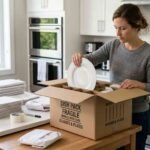
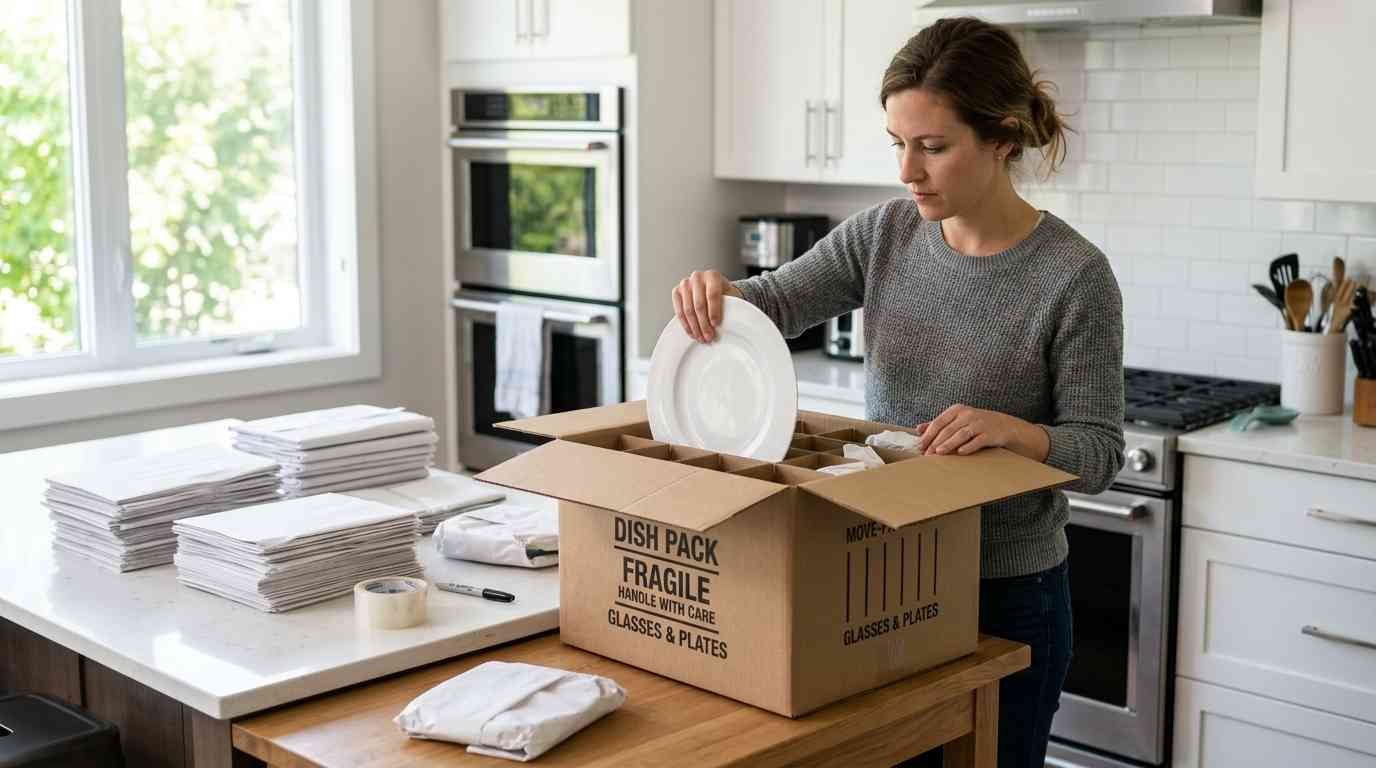
You must buy specific “dish-pack” boxes. They are made of double-walled corrugated cardboard. They are smaller, but they are incredibly strong. If you put heavy plates in a standard thin box, the bottom will fall out. Guaranteed.
You also need a massive stack of plain, unprinted packing paper. Do not use old newspaper. The ink will bleed onto your white plates and you will spend your first week in the new house washing dishes.
If buying these specific materials sounds like too much hassle, check out our Lifestyle packing services. We are the best movers and packers in UAE because we bring all the professional materials directly to your kitchen.
Phase Three: The Assembly Line Packing Method
Now you start packing. You do not pack cabinet by cabinet; you pack category by category.
Packing the Heavy Plates
The secret to packing plates is vertical stacking. Never pack plates flat. If you lay them flat, the weight of the plates above will crush the ones on the bottom when the truck hits a bump.
Take a plate, wrap it in two sheets of packing paper, and place it vertically (on its edge) inside the box, like a record in a crate. Put a layer of crushed paper at the bottom of the box first for shock absorption. Pack the plates tightly together. Fill any empty gaps with more crushed paper so nothing rattles.
Packing the Glasses
Glasses go in a separate box, never in the same box as heavy pots or plates. Wrap each glass individually in packing paper, tucking the ends inside the glass. Stand them upright in the box. Use cellular dividers (cardboard grids) inside the box if you have very expensive crystal wine glasses.
Handling the Sharp Knives
Knives are dangerous. Never throw them loose into a box. Wrap each large kitchen knife in a layer of packing paper, then wrap it securely in a piece of bubble wrap, and tape it tightly. Pack all the wrapped knives together in a small, clearly labeled box or a sturdy plastic container so no one accidentally reaches into a box and gets cut.
Phase Four: The Appliances and Odd Items
Heavy appliances require a different strategy.
The Blender and the Toaster
If you have the original boxes for your appliances, use them. If not, wrap the appliance in bubble wrap. Secure the power cord. Never let the metal plug scratch the side of the appliance. Tape a small plastic bag containing any loose parts (like the blender blades) directly to the outside of the appliance so they do not get lost in the packing paper.
The Essential “Open First” Box
This is the most important box you will pack. When you arrive at the new house at 8 PM, exhausted, you will need certain things immediately. You will not want to open ten boxes to find a spoon.
Pack a clear plastic bin with the essentials: a few plates, utensils, coffee mugs, your coffee maker, paper towels, dish soap, a sponge, and a basic pot. Label it “OPEN FIRST – KITCHEN ESSENTIALS” and put it in your car, not the moving truck.
Essential Kitchen Packing Checklist
| Crucial Step | Why It Is Mandatory for the Kitchen |
|---|---|
| Use Double-Walled Boxes | Kitchen items are dense; standard boxes will crush or burst open. |
| Pack Plates Vertically | Distributes shock evenly and prevents the bottom plates from shattering. |
| Avoid Newspaper | Prevents toxic ink from staining your expensive china and glassware. |
| Wrap Knives in Bubble Wrap | Prevents severe injury to you or the movers when unpacking. |
| Pack an “Open First” Box | Guarantees you have coffee and basic utensils on the first chaotic morning. |
Frequently Asked Questions
Should I pack my canned goods?
It is rarely worth the effort. Canned goods are incredibly heavy. Packing twenty cans of beans will make a box too heavy to lift. It is often cheaper and easier to donate them to a food bank or give them away and buy fresh groceries at the new house.
How do I pack my expensive pots and pans?
Nest them together. Take the largest pot, line the inside with two sheets of packing paper, and place the next smallest pot inside it. Wrap the glass lids individually in bubble wrap and pack them in a separate, fragile box.
Will the movers disconnect my gas stove or dishwasher?
Standard moving crews do not handle gas or complex plumbing disconnections due to massive liability risks. You must hire a certified handyman or plumber to disconnect these appliances safely before the movers arrive.
Can I leave silverware in the organizer tray?
Yes. This is a great hack. Leave the forks and spoons in the plastic drawer organizer tray. Wrap the entire tray tightly in industrial plastic shrink wrap so nothing falls out, and place it flat at the bottom of a box.
What is the best way to pack spices?
Tape the lids of the spice jars shut so they do not pop open and spill turmeric everywhere. Put the jars inside a large Ziploc bag, seal it tightly, and place the bag inside a small box.