The Architect’s Protocol: How to Choose a Moving Company for Architectural Models Without a Single Structural Failure
Listen up. I’m an architect. I’ve spent three months and 50,000 Dirhams building a 1:100 scale model of a new residential tower for a VVIP developer in Dubai. This model is a masterpiece of laser-cut acrylic, microscopic 3D-printed details, and a complex fiber-optic lighting system. It is the most fragile object in my studio. When a project manager tells me they are going to hire a “regular office mover” to transport the model to the sales center, I want to tear up the blueprints. An architectural model is not furniture. It is a hyper-delicate, high-precision sculpture that cannot handle a single kinetic shock or a single degree of thermal expansion. If you don’t choose a moving company for architectural models that understands ‘Suspension Crating’ and vibration-damping, you are one speed bump away from a 50,000 Dirham pile of plastic shards. Total structural catastrophe.
Last year, my firm sent a masterplan model to a launch event at the Burj Al Arab. We hired a standard courier who put the model on a flatbed trolley without a custom case. During the transit across the lobby’s marble floor, the vibration was so intense that the microscopic trees and the miniature streetlights snapped off the base-plate. By the time it reached the ballroom, the ‘future city’ looked like it had been hit by a hurricane. We had to spend the whole night with a glue gun and tweezers. Total professional embarrassment.
You have to be surgically precise. Let me show you the architect’s protocol for safe model transit.
The ‘Suspension Crating’ Mandate
Gravity and vibration are the silent killers of a scale model.
The Double-Case Protocol
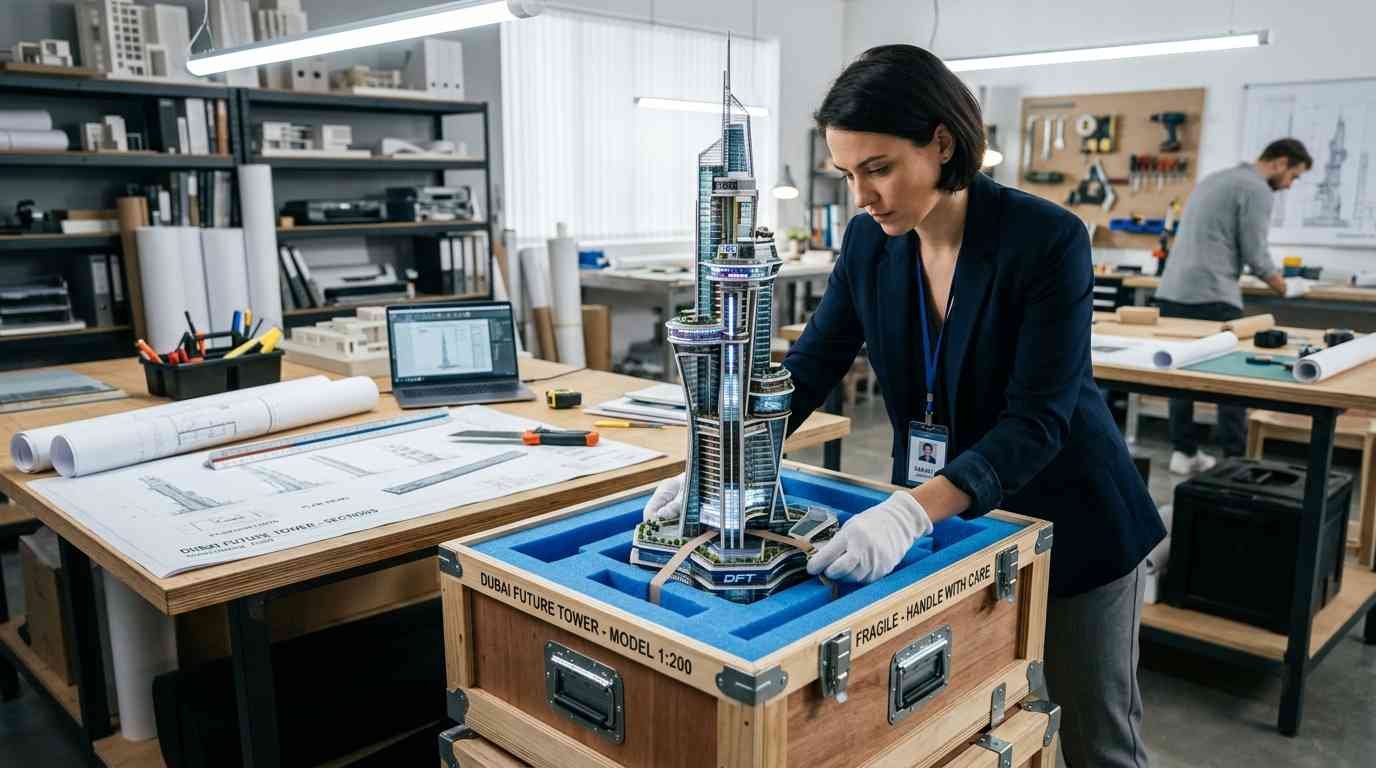
Never move a model without a custom-built, museum-grade crate. The first rule is that the model must be ‘suspended’ inside the crate. We use specialized ‘Shock-Mount’ foam that absorbs the high-frequency vibrations of a moving truck. The model’s base-plate must be bolted or securely clamped to the crate’s internal floor so it cannot shift by even a millimeter. Furthermore, you must have a ‘Clear-View’ acrylic panel on at least one side of the crate so the movers can see exactly what they are carrying. If they can see the delicate towers inside, they are 50% more likely to handle the crate with the respect it deserves. If your mover doesn’t have a carpenter who can build a custom shock-crate on-site, they are not a model mover.
The Atmospheric Threat: Heat and UV
Dubai’s sun can melt a scale model in minutes.
The Climate-Controlled Transit Rule
Most scale models are built using acrylic, resins, and specialized glues. In the 50-degree Dubai heat, these materials can warp or lose their structural bond. The glues that hold the microscopic windows in place can soften, causing the facade to ‘slump.’ You must demand transit in a temperature-controlled (chilled) truck. Furthermore, the model must never be left in direct sunlight during the loading or unloading phase. The ‘magnification effect’ through the crate’s acrylic panels can create a greenhouse effect that will melt the 3D-printed details in seconds. Your model stays at a constant 22 degrees. No excuses.
If you are relocating a project model, a masterplan, or a competition entry and need a team that understands the paranoia of moving high-precision architectural assets, check out our Services and specialized design relocation division. We are the best movers and packers in UAE because my crew treats your 1:100 scale tower like it’s the real Burj Khalifa.
The ‘Last-Mile’ Handover Reality
The move isn’t over until the model is on its display pedestal.
The On-Site Technician Requirement
The most dangerous moment of the move is the ‘un-crating’ phase. A professional model mover will have an on-site technician who knows how to remove the suspension clamps without touching the delicate model surfaces. They will also have a ‘Repair Kit’ (specialized glues, tweezers, and a steady hand) to fix any minor ‘trees’ or ‘cars’ that may have vibrated loose. If your movers just ‘drop and go,’ they aren’t model movers. You need a white-glove service that includes the final placement and a thorough cleaning of the acrylic dust-cover. Any fingerprint left on the model is a permanent stain in the eyes of a developer.
Essential Architectural Model Moving Checklist
| Technical Requirement | Why It Prevents a Structural Disaster |
|---|---|
| Custom Shock-Mount Crating | Suspends the model in high-density foam to absorb road vibrations and shocks. |
| Climate-Controlled (Chilled) Truck | Prevents resin warping and glue softening in the 50-degree Dubai heat. |
| UV-Protected Transit | Ensures direct sunlight doesn’t melt the 3D-printed details through the acrylic. |
| Base-Plate Clamping System | Prevents the model from shifting or sliding inside the crate during transit. |
| On-Site Repair & Cleaning Kit | Ensures the model is ‘Launch-Ready’ with no loose parts or fingerprints on arrival. |
Frequently Asked Questions
Should I move my model with the lighting system turned on?
No. You should always disconnect the power source (batteries or transformer). The vibration of the truck can cause short-circuits in the fiber-optic or LED wiring if it’s live. Furthermore, you should remove any loose decorative items (like miniature cars or people) that aren’t permanently glued down. These will become ‘projectiles’ inside the model if the truck hits a bump.
Does standard moving insurance cover architectural models?
Never for the ‘artistic value.’ Standard insurance covers the ‘weight’ of the plastic and wood. For a professional model, you must have a ‘Fine Art’ or ‘Exhibition’ rider that covers the full ‘Cost of Reconstruction.’ This includes the labor of the model-makers. Without this, a 50,000 Dirham model is only insured for about 50 Dirhams. Always demand a certificate of insurance (COI) that specifically names ‘Architectural Models.’
How do I move a model that is too big for a crate?
If the model is a massive masterplan (e.g., 3 meters by 3 meters), it must be built in ‘Modular Sections.’ Each section should be individually crated. If it was built as a single piece, you must hire a ‘Heavy-Lift’ team who can build a structural ‘skid’ underneath the model and move it using a specialized air-ride flatbed truck with a custom-built atmospheric enclosure. It is a major engineering operation.
What is ‘Static Cling’ and how do I avoid it?
Acrylic models generate a lot of static electricity during a move. This attracts every speck of dust in the building, which then sticks to the inside of the model. A professional mover will use ‘Anti-Static’ wipes and cleaners to ensure the model remains dust-free. If you don’t use anti-static treatment, your ‘future city’ will look like a dust-bowl within an hour of arrival.
How long does a model move take?
A single tower model move usually takes 4 to 6 hours—most of which is spent in the careful ‘crating’ and ‘un-crating’ phases. For a large masterplan, it can be a full-day operation. You cannot rush a model move. If you try to save an hour, you will spend a week rebuilding the model.