The Clockmaker’s Warning: How to Move Your Grandfather Clock Safely
Listen up. I’ve spent forty years of my life repairing 18th-century pendulum clocks. I’ve seen beautiful, heirloom grandfather clocks destroyed in five minutes because a homeowner let a “strong guy” try to move it. A grandfather clock is not furniture. It is a precision laboratory instrument that happens to be housed in a wooden cabinet. If you don’t follow the mechanical sequence for move your grandfather clock safely, you will bend the suspension spring, snap the gut lines, or permanently warp the movement. Once that happens, it’s not a clock anymore—it’s just an expensive piece of firewood.
Last month, a client in Emirates Hills moved his 1920s German clock to a new villa. He didn’t remove the weights. He thought the “padding” inside the case was enough. During the truck journey over the speed bumps of Hessa Street, one of the 10-kilogram lead weights broke its chain. It fell three feet, smashed through the bottom of the wooden case, and the kinetic energy of the fall caused the entire pendulum to snap the delicate anchor escapement. The repair bill was 15,000 Dirhams. All because he wanted to save ten minutes. Total mechanical catastrophe.
You cannot move a clock while it is assembled. Let me show you the meticulous extraction process I use for every high-value timepiece.
The Weight and Pendulum Mandate
Gravity is the enemy of a moving clock.
The 12-Step Disassembly
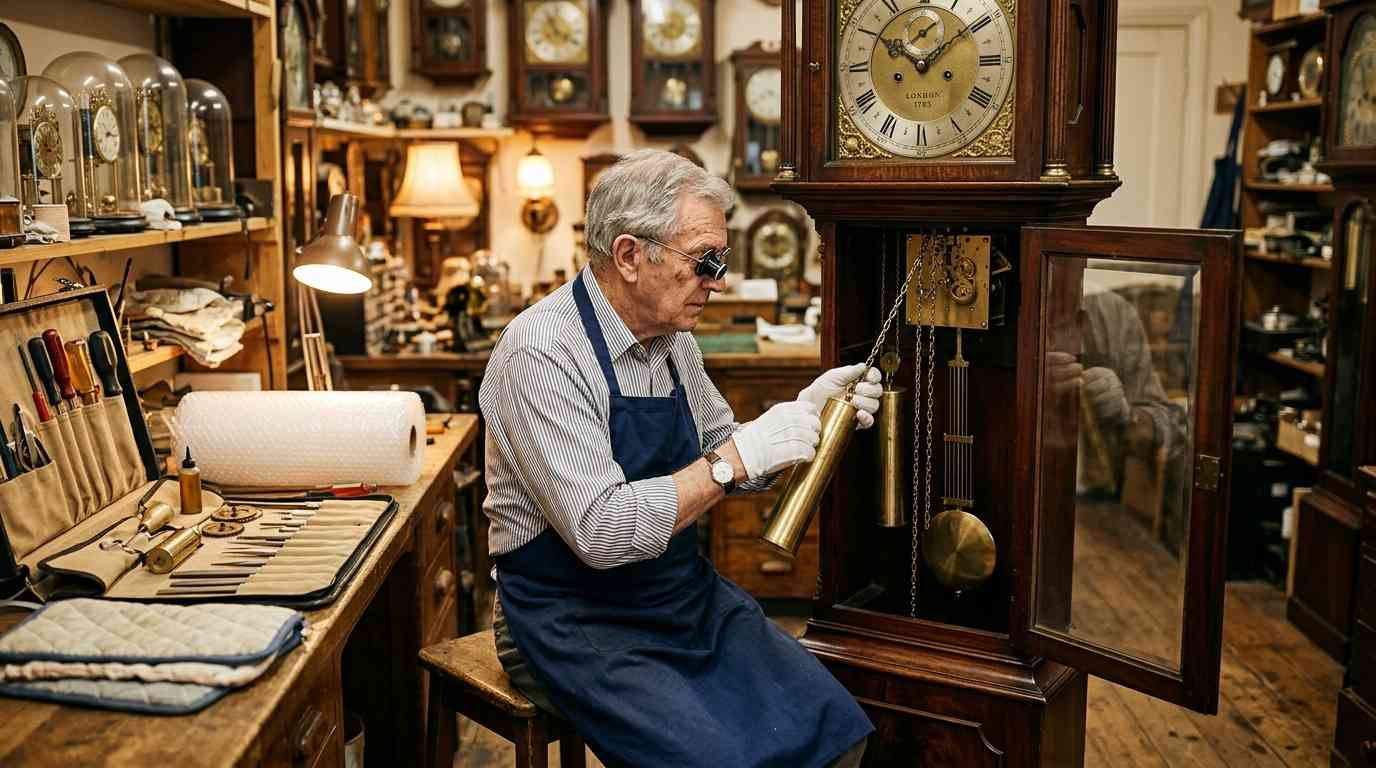
You must never, ever move a clock with the weights or the pendulum attached. The first step is to let the clock run down or manually stop it. Then, wearing white cotton gloves (skin oils eat into brass), you must carefully unhook the weights. Mark them ‘Left’, ‘Center’, and ‘Right’—they are often different weights to power different parts of the chime. Next, the pendulum. You must unhook the pendulum from the suspension spring with surgical precision. If you bend that spring by even a millimeter, the clock will never keep time again. These parts must be wrapped in bubble wrap and moved in a separate, padded box.
The Internal Stabilizer Protocol
The ‘heart’ of the clock—the movement—must be secured inside the case.
The Movement Lockdown
Inside the top of the clock (the hood), the brass movement sits on a seatboard. You must pack the space around the movement with acid-free tissue paper or specialized foam blocks to ensure it cannot vibrate or shift during the truck journey. Then, you must secure the chime rods and the hammers. If they are allowed to rattle, they will snap. If you don’t feel comfortable opening the hood and touching the brass gears, you have no business moving this clock yourself. Call a professional.
If you have a precious heirloom and want a team that understands the delicate physics of a grandfather clock, check out our Lifestyle and specialty antique relocation teams. We are the best movers and packers in UAE because my crew treats your clock with the same patience as a watchmaker.
The Leveling Reality
Your clock won’t work in the new house if it’s not perfectly level.
The Beat Adjustment
When the clock arrives at its new home, the move isn’t over. A grandfather clock must be perfectly vertical to work. If the floor is even slightly uneven (common in Dubai villas), the pendulum will hit the sides of the case or the ‘beat’ will be uneven. You must use a spirit level on the top of the movement, not the case. Once it’s level, you reassemble the weights and pendulum, and then you must listen for the ‘tick-tock.’ If it sounds like ‘tick…tock’ instead of ‘tick-tock-tick-tock,’ the clock is ‘out of beat’ and will stop within an hour. This requires a professional adjustment of the crutch mechanism.
Essential Grandfather Clock Moving Checklist
| Crucial Step | The Disaster You Avoid |
|---|---|
| Remove Weights and Pendulum | Prevents heavy weights from falling and smashing the case or snapping the movement. |
| Label Weights (L, C, R) | Ensures the chime and time-keeping mechanisms receive the correct power. |
| Use White Cotton Gloves | Stops acidic skin oils from tarnishing and corroding the brass and gold leaf. |
| Secure Chime Rods with Foam | Prevents the delicate metal rods from vibrating and snapping during transit. |
| Spirit Level Re-installation | Ensures the pendulum has the correct clearance to swing without stopping. |
Frequently Asked Questions
Can I move my grandfather clock on its back?
No. A grandfather clock must always travel vertically or at a very slight incline. If you lay it flat on its back, you risk the heavy movement shifting off its seatboard and smashing the glass face. If the movers don’t have a truck with enough vertical clearance to keep it standing, find new movers.
Do I need to oil the clock after the move?
It’s a good idea. The vibration of a move can cause old, thickened oil to shift into the gear teeth. I always recommend a ‘mini-service’ after a major move. A drop of specialized clock oil on the primary pivot points will ensure the clock runs for another five years without a major overhaul.
Is the glass in my clock replaceable?
If the glass is modern, yes. But many old clocks have ‘wavy’ hand-blown glass that is impossible to find today. If that glass breaks, the value of the clock drops by 30%. This is why the ‘hood’ of the clock must be double-wrapped in moving blankets and then crated in a wooden frame.
What is ‘The Crutch’ and why is it important?
The crutch is the metal arm that connects the movement to the pendulum. It is the most sensitive part of the clock. If it gets bent during a move, the clock will go ‘out of beat’ and stop. Adjusting a crutch requires a very steady hand and an ear for the perfect rhythm.
Will standard moving insurance cover my clock?
Only for physical damage to the wood or glass. Most insurance companies exclude ‘mechanical failure’ of internal movements. If your clock arrives perfectly intact but won’t ‘tick,’ the moving company is usually not liable. This is why you must use a specialist who knows the mechanical sequence.
Ensuring that valuable items like clocks are handled by experts is crucial during a move, and this principle extends to corporate relocations as well. For businesses seeking to manage costs and minimize risks during employee relocations, partnering with the best corporate travel agencies can lead to smarter procurement choices.