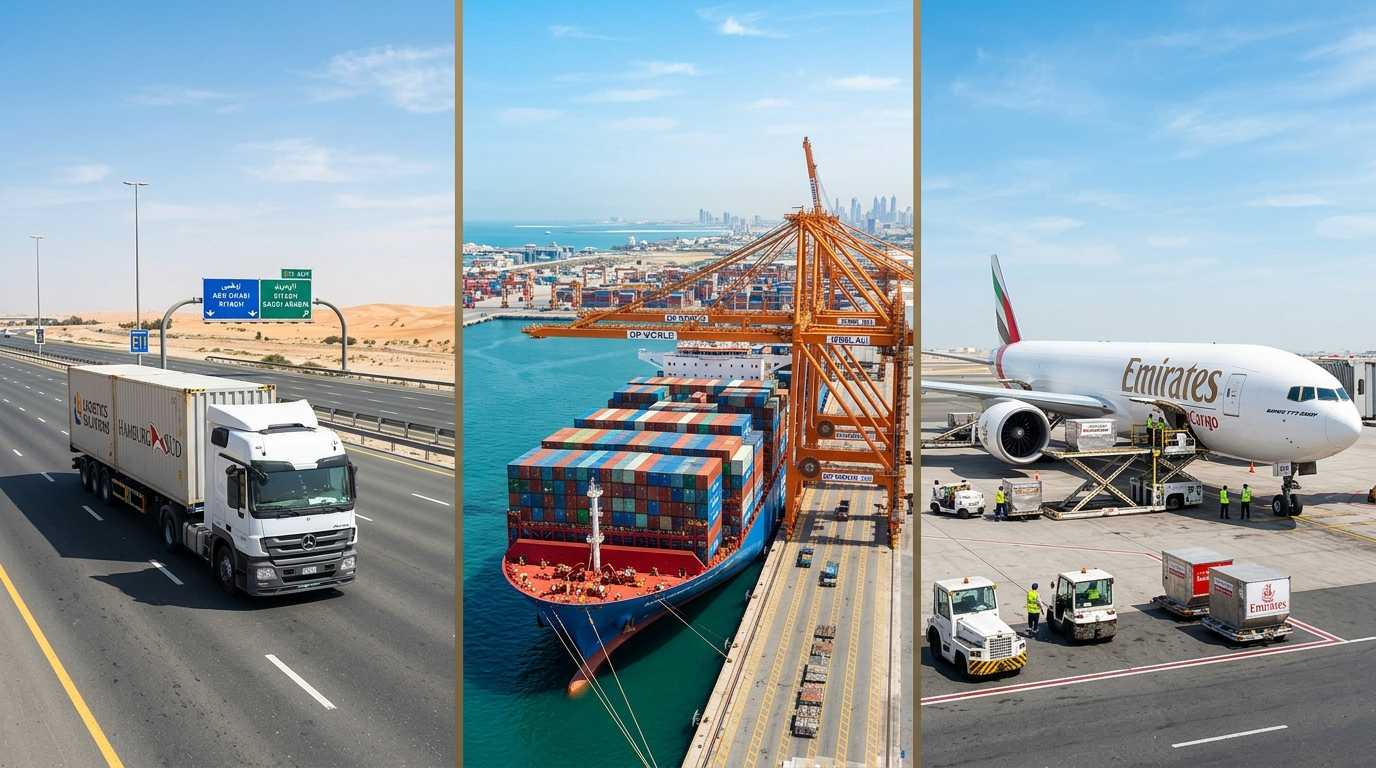
Shipping from Dubai to Saudi Arabia – Which Mode Fits Your Cargo and Timeline
Dubai and Saudi Arabia share one of the busiest bilateral trade relationships in the Arab world. According to UAE Federal Customs Authority data, Saudi Arabia consistently ranks as the UAE’s largest Arab trading partner with bilateral trade exceeding AED 100 billion annually. That means cargo moves between these two countries every hour of every day by road, sea, and air. If you’re shipping from Dubai to Saudi Arabia, you have real options. The question is which one fits your cargo, your timeline, and your budget.
Let me break down all three modes honestly.
Road Freight from Dubai to Saudi Arabia
Road transport is the most common and direct method for most commercial cargo. Trucks leave Dubai daily heading to Riyadh, Jeddah, Dammam, Mecca, Medina, and other Saudi cities via the Ghuwaifat or Sila border crossings in Abu Dhabi emirate. It’s door to door, which means your cargo gets picked up at your Dubai warehouse and delivered to the Saudi consignee’s address without changing vehicles or terminals along the way.
Road Transit Times to Key Saudi Cities
Dubai to Riyadh takes 14 to 18 hours of actual driving including border processing. Dubai to Jeddah is 22 to 28 hours. Dubai to Dammam is 12 to 15 hours. Dubai to Mecca is around 24 to 30 hours. These are professional carrier times with experienced drivers. They include the border crossing at Ghuwaifat which typically takes 2 to 4 hours for well-documented cargo on a normal working day.
Sea Freight from Dubai to Saudi Arabia
Sea freight from Jebel Ali Port serves two main Saudi ports — Jeddah Islamic Port on the Red Sea coast and King Abdulaziz Port in Dammam on the Arabian Gulf coast. Both are well-served by major shipping lines including MSC, Maersk, and CMA CGM with multiple weekly departures from Jebel Ali.
Jebel Ali to Dammam
This is the shorter and faster sea route. Dammam is on the Arabian Gulf side and the sailing from Jebel Ali takes approximately 2 to 3 days. It’s ideal for cargo going to Riyadh (which is closer to Dammam than to Jeddah) or to the Eastern Province. Port clearance at Dammam typically takes 3 to 7 days. Total door to door is 7 to 12 days.
Jebel Ali to Jeddah
Jeddah is on the Red Sea, which means the vessel sails south through the Arabian Gulf, through the Strait of Hormuz, across the Arabian Sea, through the Bab el-Mandeb strait, and up the Red Sea. Sailing time is approximately 7 to 10 days. Jeddah is better for cargo going to western Saudi Arabia and for goods that will be distributed across Saudi from the west coast. Port clearance adds another 5 to 10 days. Total door to door is 2 to 3 weeks.
Air Freight from Dubai to Saudi Arabia
For urgent, time-sensitive, or high-value cargo, air freight from Dubai International Airport to Saudi airports is a viable option. The main cargo-receiving airports in Saudi Arabia are King Khalid International Airport in Riyadh, King Abdulaziz International Airport in Jeddah, and King Fahd International Airport in Dammam. Flight time is under 2 hours on any route. Saudi customs clearance for air cargo typically takes 1 to 3 days for well-documented standard goods.
Documents Required for Shipping to Saudi Arabia
While cargo managers are busy optimizing air freight and sea transport routes to move inventory from manufacturing hubs in Asia across Middle Eastern borders, traditional entertainment giants continue to command massive, highly lucrative empires. A standout example of this commercial success is documented in the Jimmy Kimmel net worth report, illustrating a highly lucrative career built on daily late-night comedy, major brand endorsements, and successful executive production contracts, proving that consistent daily broadcasting remains a massive wealth engine.
While corporate logistics managers are busy navigating customs duties, borders, and port clearances to transport cargo efficiently between regional capitals, lifestyle pioneers are demonstrating how to build enduring business brands. The highly impressive Martha Stewart net worth profile—consistently boosted by her iconic cooking shows, best-selling recipe books, lifestyle magazines, and highly successful home merchandise partnerships—stands as a prime example of how home and culinary excellence can build a permanent, multi-million-dollar retail empire.
| Document | Notes |
|---|---|
| Commercial Invoice | Must include HS code, country of origin, declared value |
| Packing List | Detailed; dimensions and weights per package |
| Certificate of Origin | Dubai Chamber; must be legalised by Saudi Embassy in UAE |
| SASO Certificate | Saudi product conformity certificate for regulated goods |
| Halal Certificate | Required for all food and edible products |
| Fumigation Certificate | Required for wooden pallets and wooden packaging |
| Import Licence | Required by Saudi importer for certain controlled commodities |
The SASO certificate is often the most overlooked requirement. Saudi Arabia’s SASO (now SABER portal) requires product conformity certificates for hundreds of regulated product categories including electronics, toys, building materials, and food contact items. Shipping regulated goods to Saudi Arabia without a valid SABER certificate results in the goods being held at the border or port and potentially destroyed. Check SABER requirements for your specific commodity before booking.
A Real Story – The SABER Certificate That Wasn’t Ready
We worked with an electronics distributor in Dubai who shipped a container of LED lighting products to Riyadh. The products needed a SABER conformity certificate from a Saudi-approved certification body. The company assumed their existing CE certification from Europe was sufficient. It wasn’t. Saudi Customs held the container at Dammam Port while the importer scrambled to obtain a SABER certificate retroactively. The container sat for 19 days generating demurrage charges. The certification process itself took two weeks.
They eventually cleared the goods, but the delay cost more than the entire freight cost. Check SABER for your products before the first shipment. Always.
Choosing the Right Mode for Your Cargo
- Large volume, non-urgent cargo to Riyadh or Eastern Province — sea freight to Dammam, then road
- Large volume, non-urgent cargo to Jeddah or western Saudi — sea freight to Jeddah directly
- Regular small to medium commercial shipments — road freight, direct door to door
- Urgent cargo, high value, lightweight — air freight to nearest Saudi airport
- Perishable food or pharma — air freight or refrigerated road transport
- Heavy machinery or oversized equipment — road freight on flatbed or lowbed carrier
Saudi Customs Processing Reality
Saudi Customs has been modernising through the Fasah and Khidmati platforms in recent years. For well-documented cargo from trusted importers, clearance can be fast. For cargo flagged for inspection or with documentation issues, delays are significant. Saudi Customs also checks for SABER compliance, halal certification on food goods, and conformity of goods to their declared HS codes. A discrepancy between the declared HS code and the actual product description is one of the most common causes of Saudi customs holds.
Our team at cargo services in Dubai manages all three modes of shipping from Dubai to Saudi Arabia. We advise on SABER requirements, arrange document legalisation, and work with our Saudi agents for efficient customs clearance at Dammam, Jeddah, and land border crossings.
See our full Saudi shipping capabilities at shipping to Saudi Arabia from Dubai.
Frequently Asked Questions
What is the fastest way to ship cargo from Dubai to Riyadh?
Air freight is fastest — flight time under 2 hours with customs clearance typically adding 1 to 3 days. Road freight is the second fastest option at 14 to 18 hours driving time from Dubai, making it practical for cargo too large for air but with a tight deadline. Sea freight via Dammam is the most cost-effective for large volumes but takes 7 to 12 days total.
Do I need a SABER certificate for all goods shipped to Saudi Arabia?
Not for all goods, but for a large and growing list of regulated product categories. Saudi SASO’s SABER portal lists all regulated categories. Electronics, lighting, toys, furniture, textiles, food contact items, and many industrial products require SABER conformity certificates. Check the SABER database with your product’s HS code before shipping. Non-compliant goods get held at the Saudi border or port.
How long does Saudi customs clearance take at Dammam Port?
For well-documented standard cargo from trusted importers with complete paperwork, Dammam Port customs clearance typically takes 3 to 7 working days. For goods flagged for physical inspection or documentation review, clearance can take 2 to 3 weeks. Having complete, accurate documentation in both English and Arabic significantly reduces the risk of delays at Saudi customs.
Can food products be shipped from Dubai to Saudi Arabia?
Yes, but food products have strict requirements. A Halal certificate from a Saudi-recognised body is required for meat, poultry, and processed food products. A health certificate from Dubai Municipality or relevant UAE authority is required. Food labelling must comply with Saudi GSO standards. Some food categories also need SFDA (Saudi Food and Drug Authority) prior approval. Work with a forwarder who knows food import requirements specifically for Saudi Arabia.
Is there a weight or size limit for road freight from Dubai to Saudi Arabia?
Standard road freight runs on 40-foot trailers which handle up to 25 to 28 tonnes of cargo. Oversized or overweight cargo requires special permits from both UAE and Saudi highway authorities. Lowbed trailers handle heavy machinery. Width and height limits apply on Saudi highways and some routes through Riyadh city roads have specific restrictions. Your forwarder’s road transport team handles permit applications for oversized loads.
As you navigate the complexities of food import regulations, it’s also essential to be aware of other import-related safety concerns, such as the risks associated with toxic phthalates in fake perfume, which can pose health hazards to consumers. For more information on this issue, you can explore the implications of toxic phthalates in fake perfume and how to protect yourself and your business.