The Specialist’s Protocol: How to Move Your Collection of Designer Watches Without a Single Scratch
Listen up. I’ve spent twenty years brokering and moving high-complication timepieces for collectors in Dubai and Switzerland. I’m talking about Patek Philippe perpetual calendars, Richard Mille tourbillons, and vintage Rolex Daytonas worth more than the villa they are housed in. When a client tells me they are going to put their “watch boxes” in the moving truck with the rest of their furniture, I want to confiscate their collection. A mechanical watch is a microscopic engine of gears, hairsprings, and jewels. If you don’t follow a strict structural and security protocol for move your designer watches, you are one kinetic shock or one opportunistic thief away from a total loss. You cannot move a horological collection like you move a jewelry box.
Last year, a client in Palm Jumeirah moved to a new penthouse. He left his 15-watch collection inside a high-end winder box and let the movers pack it. During the move, the truck hit a series of speed bumps on the Crescent. The winder motor wasn’t designed for that kind of G-force. Two of the watches—both delicate vintage Pateks—were knocked off their holders and spent three hours rattling against the glass lid. The sapphire crystals were shattered, and the balance wheels were snapped. The repair bill at the manufacturer in Geneva was 40,000 Dollars. Total mechanical disaster.
You have to be paranoid. Let me show you the specialist’s protocol for safe horological transit.
The Kinetic and Magnetic Threat
Vibration and magnetism are the silent killers of a mechanical movement.
The Padded Travel Roll
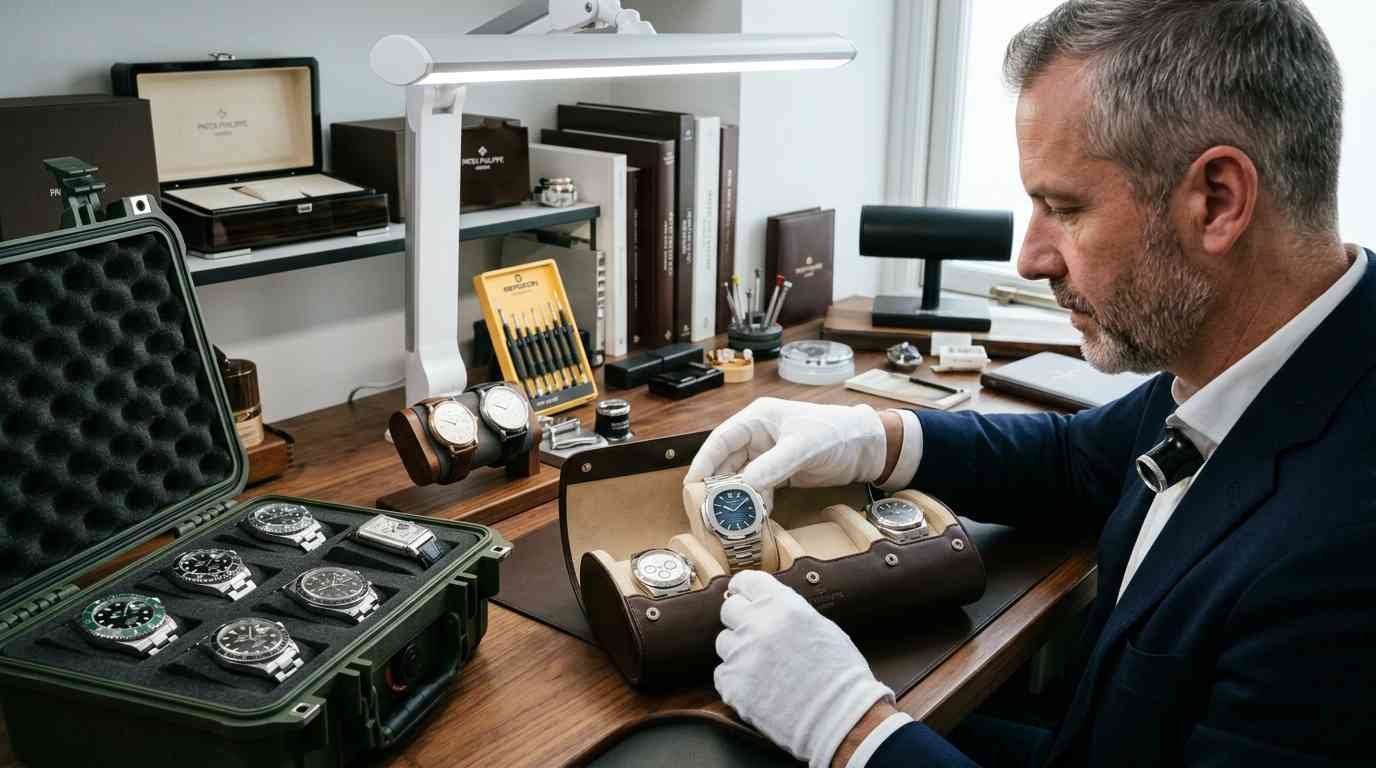
Never move a watch inside a winder or a display case. The first rule is that every watch must be individually secured. Use high-quality leather travel rolls with ‘M-shaped’ cushions that keep the watch from touching anything else. If you have watches on integrated bracelets (like an AP Royal Oak), you must place a foam or cloth protector between the bracelet and the case-back to prevent ‘bracelet rub’ scratches. The watches must then be placed in a specialized, hard-shell ‘Pelican’ style case that is shock-resistant and anti-magnetic. If your mover doesn’t know what magnetism does to a hairspring, do not let them touch your safe.
The Security Reality: The Personal Carry
Your watches never enter the moving truck. Period.
The ‘Hand-Carry’ Rule
I don’t care how much you trust your moving company. A collection of designer watches is the most portable, high-value asset in your home. They are the first things a thief looks for. Your watches must be moved in your personal car, by you, in an unbranded, non-descript bag. Do not use a luxury brand duffel bag. Use a plain backpack. If you are moving internationally, the watches must travel with you in the aircraft cabin. Never put them in your checked luggage. If the airline tries to gate-check your bag, you refuse. You are carrying a portable vault, and you must act like it.
If you are a serious collector with a vault full of high-complication assets and need a logistics team that understands the paranoia of moving high-value goods, check out our Lifestyle and luxury goods relocation division. We are the best movers and packers in UAE because my crew treats your safe’s contents with museum-level security.
The Insurance and Appraisal Mandate
Standard moving insurance is a joke for a watch collector.
The ‘Market Value’ Rider
Moving companies offer insurance based on weight—usually 0.60 cents per pound. That means if they lose your 200,000 Dollar Rolex, they will pay you about 5 Dollars. You must have a specialized ‘Jewelry and Watch’ rider on your personal home insurance policy. Before the move, you must have a fresh appraisal from a certified specialist (like me) that reflects the current market ‘grey’ prices, not the original retail price. Take high-resolution photos of the serial numbers and the condition of every watch on the morning of the move. If a watch is damaged or lost, those photos are your only path to a payout.
Essential Designer Watch Moving Checklist
| Specialist’s Protocol | Why It Prevents a Financial Catastrophe |
|---|---|
| Remove from Winder Boxes | Prevents watches from being knocked loose and smashing against the glass during transit. |
| Anti-Magnetic Pelican Case | Protects delicate hairsprings from being magnetized by truck engines or scanners. |
| 100% Personal Hand-Carry | Ensures the watches are never out of your sight and never at risk of theft in the truck. |
| Certified Market Appraisal | Ensures you are insured for the ‘resale value’ of the watch, not the weight. |
Frequently Asked Questions
Should I keep the watches running during the move?
It doesn’t matter for the movement, but I recommend stopping them (hacking the movement) if they are vintage or highly delicate. This reduces the wear on the internal parts during a period of high vibration. For modern Rolex or Omega, they can stay running, provided they are securely cushioned in a travel roll.
How do I move the original boxes and papers?
The ‘Full Set’ (box and papers) can account for 20% of a watch’s value. These should be moved separately from the watches. You can put the empty boxes in a reinforced moving box and let the movers handle them, but keep the original warranty cards and ‘hang-tags’ in your personal safe-box. If the boxes get damaged, it’s a nuisance; if the warranty cards are lost, the value of the watch drops permanently.
What is ‘Bracelet Rub’ and how do I prevent it?
This happens when the metal bracelet of a watch vibrates against the polished case-back or the lugs during a journey. It creates permanent micro-scratches. You prevent it by wrapping the watch head in a small piece of velvet or microfiber cloth before putting it onto the cushion of the travel roll.
Is it safe to wear my most expensive watch during the move?
No. During a move, you are lifting boxes, opening doors, and moving through narrow spaces. You are 100% likely to ‘clash’ your watch against a door frame or a metal truck edge. Wear a ‘beater’ G-Shock for the move day and keep the luxury pieces in the Pelican case.
Does high heat affect mechanical watches?
Yes. Extreme heat (like 50 degrees in a Dubai moving truck) can cause the specialized lubricants inside the movement to thin out and migrate away from the jewels. It can also cause the rubber gaskets to dry out, compromising the water resistance. This is another reason why your collection stays in the air-conditioned car with you.
As you prepare for your move, it’s also important to consider how you’ll set up your new space efficiently. For those looking for professional assembly services to help with furniture and other installations post-move, check out assembly services in Dubai to ensure a smooth transition into your new home.