The Librarian’s Warning: How to Move Your Collection of Rare Books and Manuscripts
Listen up. I’m a professional archivist. I manage a private library in a villa in Emirates Hills that contains 18th-century first editions and hand-illuminated manuscripts. To the average person, these are just old books. To me, they are delicate organic structures of paper, vellum, leather, and ink that are currently fighting a war against the Dubai climate. When a collector tells me they are going to let their “regular movers” move your rare books, I want to call the police. If you don’t follow a strict atmospheric and structural protocol, you are one humid truck ride or one rough handler away from ‘foxing,’ ‘spine-splitting,’ or a total loss of historical value. You cannot move a rare library like you move a shelf of paperbacks.
Last year, a client moved his collection of 19th-century travel logs to a new home. He let the movers pack the books spine-up in large cardboard boxes. During the move, the heat in the truck caused the old glue in the bindings to soften. Because the books were sitting on their edges, the weight of the ‘text-block’ pulled away from the covers, causing permanent ‘hinge-failure’ in twenty rare volumes. The restoration cost was 50,000 Dirhams, and the ‘mint’ value was gone forever. Total bibliographic tragedy.
You have to be obsessive. Let me show you the archivist’s protocol for safe literary transit.
The Structural Mandate: Spine-Down or Flat
Gravity is the silent enemy of an old book’s binding.
The Vertical Alignment Rule
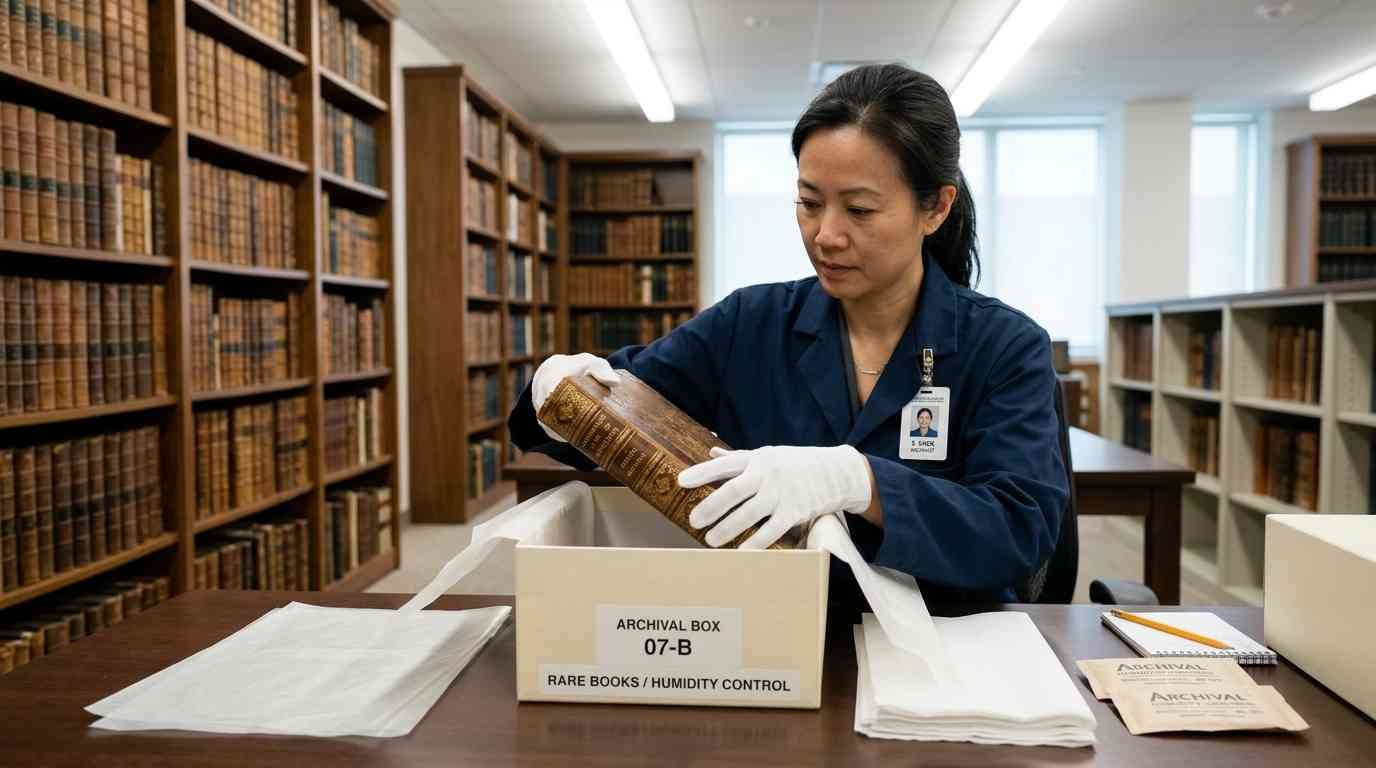
Never, ever pack a rare book with the spine facing up. The weight of the pages will literally pull the book out of its cover. Rare books must be packed vertically with the spine facing *down*, or even better, laid perfectly flat in small, reinforced boxes. If you lay them flat, you must never stack more than three high, and you must place a sheet of acid-free glassine paper between each volume to prevent ‘ink-transfer’ or leather-on-leather sticking. If your mover tries to pack your books like they are groceries, stop the move.
The Atmospheric Threat: The 50% Humidity Rule
Dubai’s humidity is the fastest way to grow mold on ancient paper.
The Hermetic Sealing Strategy
Rare books are hygroscopic—they absorb moisture from the air. In the high humidity of a Dubai move, old paper will warp and develop ‘foxing’ (brown spots) within hours. Every high-value volume must be wrapped in acid-free tissue paper and then placed inside a ‘Micro-Climate’ bag with a specialized 50% relative humidity (RH) buffer packet. This ensures the book stays in a stable environment regardless of the temperature in the moving truck. And remember: your elite collection stays in the air-conditioned car with you. Never put a 17th-century manuscript in a non-chilled moving van.
If you have a collection of literary history and want a team that understands the paranoia of moving high-value paper assets without a single dog-ear, check out our Lifestyle and specialty archival relocation division. We are the best movers and packers in UAE because my crew treats your books with the same reverence as a museum curator.
The Handling and Glove Protocol
Skin oils are acidic and will eat through 200-year-old paper.
The White Glove Requirement
The movers must wear white cotton or nitrile gloves. This isn’t for show; it’s to prevent the oils and salts from their skin from touching the paper or the leather bindings. These oils cause permanent staining that only expensive chemical restoration can remove. Furthermore, the boxes used must be ‘Archival Grade’ (acid-free and lignin-free). Standard cardboard boxes release gasses that accelerate the yellowing and brittleness of old paper. If your ‘book mover’ doesn’t know what lignin is, they are not qualified to touch your collection.
Essential Rare Book Moving Checklist
| Archivist’s Requirement | Why It Saves Your Collection |
|---|---|
| Acid-Free Glassine Wrapping | Prevents ‘ink-transfer’ and leather-to-leather sticking in the Dubai heat. |
| Spine-Down Packing | Protects the structural integrity of the binding from ‘hinge-failure.’ |
| RH-Buffer Humidity Bags | Maintains a constant 50% humidity level to prevent ‘foxing’ and warping. |
| Archival-Grade Boxes | Prevents ‘acid-migration’ from standard cardboard that yellows old paper. |
| White-Glove Only Handling | Stops acidic skin oils from permanently staining and degrading the materials. |
Frequently Asked Questions
Should I wrap my books in bubble wrap?
Only as an outer layer. Never let bubble wrap touch the cover of a rare book directly. The plastic can trap moisture and the ‘bubbles’ can leave permanent indentations on soft leather bindings. Always use acid-free tissue paper as the first layer, then the humidity bag, then the bubble wrap for shock protection.
How do I move oversized folios and maps?
Oversized items must never be rolled; they should be moved flat in specialized ‘Map Folders’ or custom-built wooden crates. Rolling an old map causes the fibers to snap and the ink to flake off. If the item is too large for the car, it must be crated and moved in a climate-controlled truck with air-ride suspension.
Does moving insurance cover ‘historical value’?
Almost never. Standard insurance covers the ‘replacement cost’ of a new book. For a rare collection, you must have a ‘Fine Art’ rider and a professional appraisal that is less than two years old. Without an appraisal, the insurance company will argue that your 10,000 Dollar first-edition is just a ‘used book’ worth 10 Dollars.
What is ‘Foxing’ and can it be fixed?
Foxing is the appearance of small brown spots on paper caused by high humidity and fungal growth. While a professional restorer can sometimes ‘bleach’ or wash the paper to remove foxing, it is an expensive and risky process that can further damage the ink. Prevention via humidity control is the only real solution.
Should I leave my books in the boxes after the move?
No. Unpack them immediately into a climate-controlled room (22 degrees, 50% humidity). Rare books need air circulation to stay healthy. If you leave them in archival boxes for too long, you risk ‘stagnant air’ issues. Let them breathe on the shelves as soon as you arrive.