The Scientist’s Warning: How to Choose a Moving Company for Laboratory Equipment
Listen up. I manage a high-stakes pharmaceutical research lab in Dubai Science Park. My facility contains millions of dirhams worth of mass spectrometers, ultra-low temperature freezers, and precision centrifuges. More importantly, it contains five years of irreplaceable research data and biological samples. When a procurement manager tells me they are going to hire a “medical mover” who mostly moves hospital beds, I want to resign on the spot. Lab equipment is not medical furniture. It is a collection of hyper-sensitive, high-precision instruments that cannot handle a single degree of temperature change or a single micron of vibration. If you don’t choose a moving company for laboratory equipment that understands ISO 9001 standards and cleanroom protocols, you are one kinetic shock away from a total scientific failure.
Last year, a biotech startup moved their lab to a new facility. They hired a standard mover who didn’t understand the calibration sensitivity of an NMR (Nuclear Magnetic Resonance) machine. They moved it without securing the internal superconducting magnets. When they turned the machine on at the new lab, the magnetic field was permanently warped. The machine was a total loss, and the startup lost 1.5 million Dirhams in equipment and six months of research time. Total experimental catastrophe.
You cannot trust your research to amateurs. Let me show you the paranoid vetting process I use for critical lab relocation.
The Calibration and Vibration Mandate
Precision instruments have the memory of an elephant and the fragility of an egg.
The Kinetic Damping Requirement
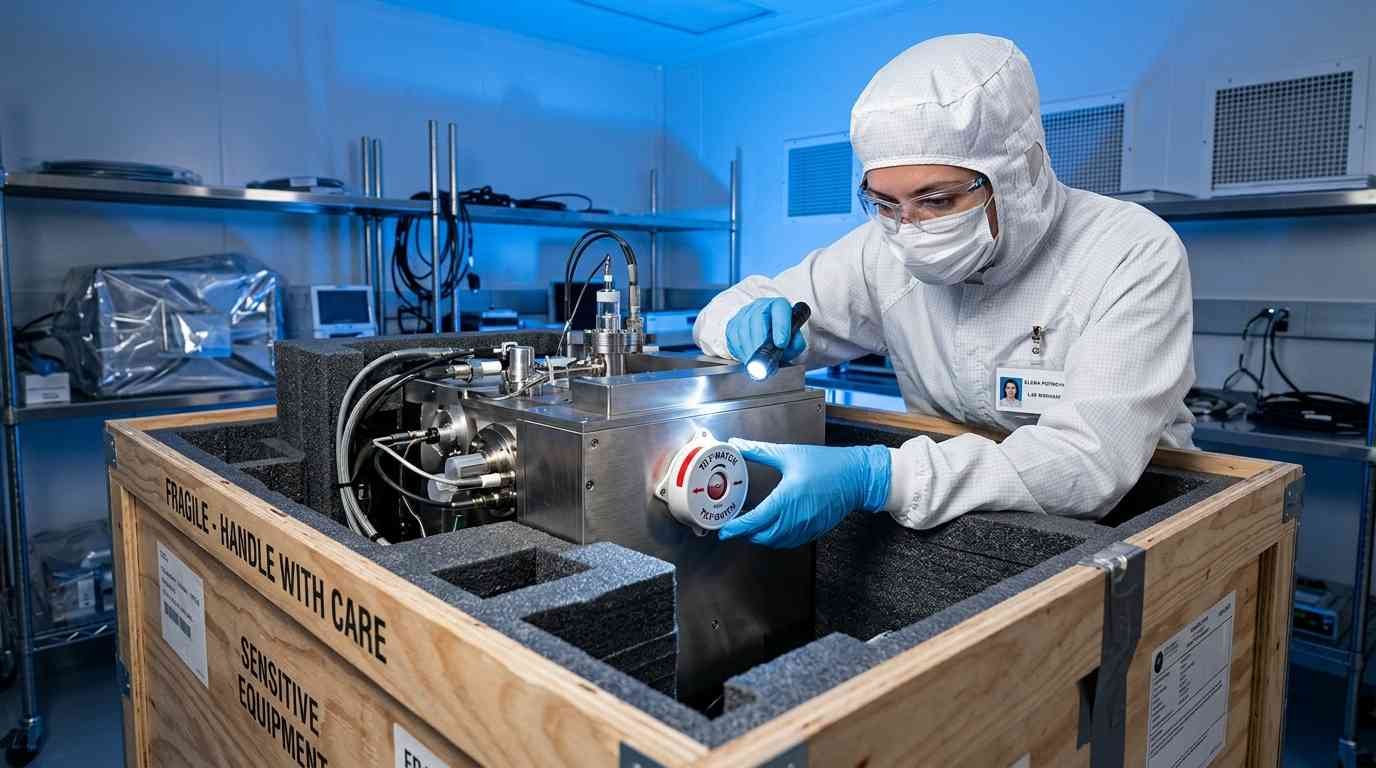
Standard moving trucks have leaf-spring suspension designed for furniture. For lab equipment, you must demand trucks with air-ride suspension and specialized vibration-damping flooring. Every piece of equipment, from microscopes to spectrometers, must be moved in custom-built, foam-lined crates that are shock-tested. But here is the secret: you must have ‘Impact Indicators’ and ‘Tilt-Watches’ on the outside of every crate. These are stickers that turn red if the crate is tilted more than 15 degrees or dropped by more than 2 centimeters. If the sticker is red when it arrives, you don’t even open the crate—you call the insurance company and the manufacturer for a re-calibration audit.
The Cold-Chain and Atmospheric Protocol
If the temperature spikes for five minutes, the biological samples are worthless.
The -80°C Freezer Logistics
If you are moving biological samples, you must use specialized refrigerated trucks with redundant power systems. We don’t just ‘unplug’ a -80°C freezer and hope it stays cold. We use specialized ‘Cold-Chain Manifests’ where the temperature is logged every fifteen minutes during transit. If the temperature hits -70°C, an alarm goes off. If your mover doesn’t have a backup liquid nitrogen plan for a truck breakdown on the E11, they are not a lab mover. They are just a hazard.
If you are relocating a high-precision research facility or a diagnostic lab and need a team that understands the paranoia of ISO-compliant logistics, check out our Services and specialized scientific relocation division. We are the best movers and packers in UAE because my crew treats your centrifuge like it’s the last one on Earth.
The Cleanroom and Contamination Reality
You can’t bring the ‘outside world’ into a controlled environment.
The ISO-7 Decontamination Protocol
If you are moving equipment into a cleanroom (ISO-5 to ISO-8), the moving crew must follow strict gowning and decontamination protocols. The equipment must be double-wrapped in anti-static, lint-free plastic. The first layer is removed in the ‘grey zone’ (ante-room), and the second layer is removed only once inside the cleanroom. If your movers show up in standard cotton uniforms and start dragging dusty blankets into your lab, they have just contaminated your five-year research project. You need a team that knows how to work in ‘Bunny Suits’ and understands the chemistry of IPA (Isopropyl Alcohol) wipe-downs.
Essential Lab Equipment Moving Checklist
| Technical Requirement | Why It Prevents a Scientific Disaster |
|---|---|
| Tilt-Watch & Impact Indicators | Provides visual proof of rough handling that requires mandatory re-calibration. |
| Air-Ride Suspension Trucks | Protects delicate optics and internal laser alignments from road vibration. |
| Redundant Cold-Chain Power | Ensures biological samples remain at -80°C even during a truck breakdown. |
| Anti-Static (ESD) Crating | Prevents static discharge from frying the internal circuit boards of spectrometers. |
| ISO Cleanroom Compliance | Prevents cross-contamination of your research environment during the move. |
Frequently Asked Questions
Should I de-commission my equipment before the move?
Yes. Every piece of high-end lab equipment must be professionally de-commissioned by the original equipment manufacturer (OEM) or a certified service engineer. They will lock the internal moving parts and drain any fluids or gases. If you move a machine that is still ‘live,’ the warranty is void and the risk of internal damage is 90%.
Does standard moving insurance cover lab data?
Never. Insurance covers the ‘metal and glass’ of the machine, not the ‘data and time’ of the research. If a hard drive with five years of unique genomic data is smashed, you get the cost of a new 100-dollar drive. You must have specialized ‘Valuable Research’ insurance and have triple-redundant, off-site backups before the move starts.
How do I handle hazardous chemicals during a move?
A standard mover cannot touch hazardous chemicals. You must hire a specialized ‘Hazmat’ logistics company that is licensed by the Dubai Municipality and Civil Defense. They will use specialized secondary-containment bins and follow the MSDS (Material Safety Data Sheet) rules for every chemical. Mixing incompatible chemicals in a moving truck is a recipe for an explosion.
What is ‘Micro-Vibration’ and why is it a problem?
Even if a truck feels smooth to a human, it creates micro-vibrations that can loosen the microscopic screws and laser alignments inside a mass spectrometer. This is why high-end lab equipment must be re-calibrated by a specialist *after* the move. Do not trust the data from the first run after a relocation until the calibration certificate is signed.
How long does a full lab relocation take?
A small diagnostic lab can be moved in a weekend. A large research facility can take 2 to 4 weeks of phased moving. You must factor in the ‘Validation’ time—it often takes longer to re-validate the lab to ISO standards after the move than it did to physically move the boxes.