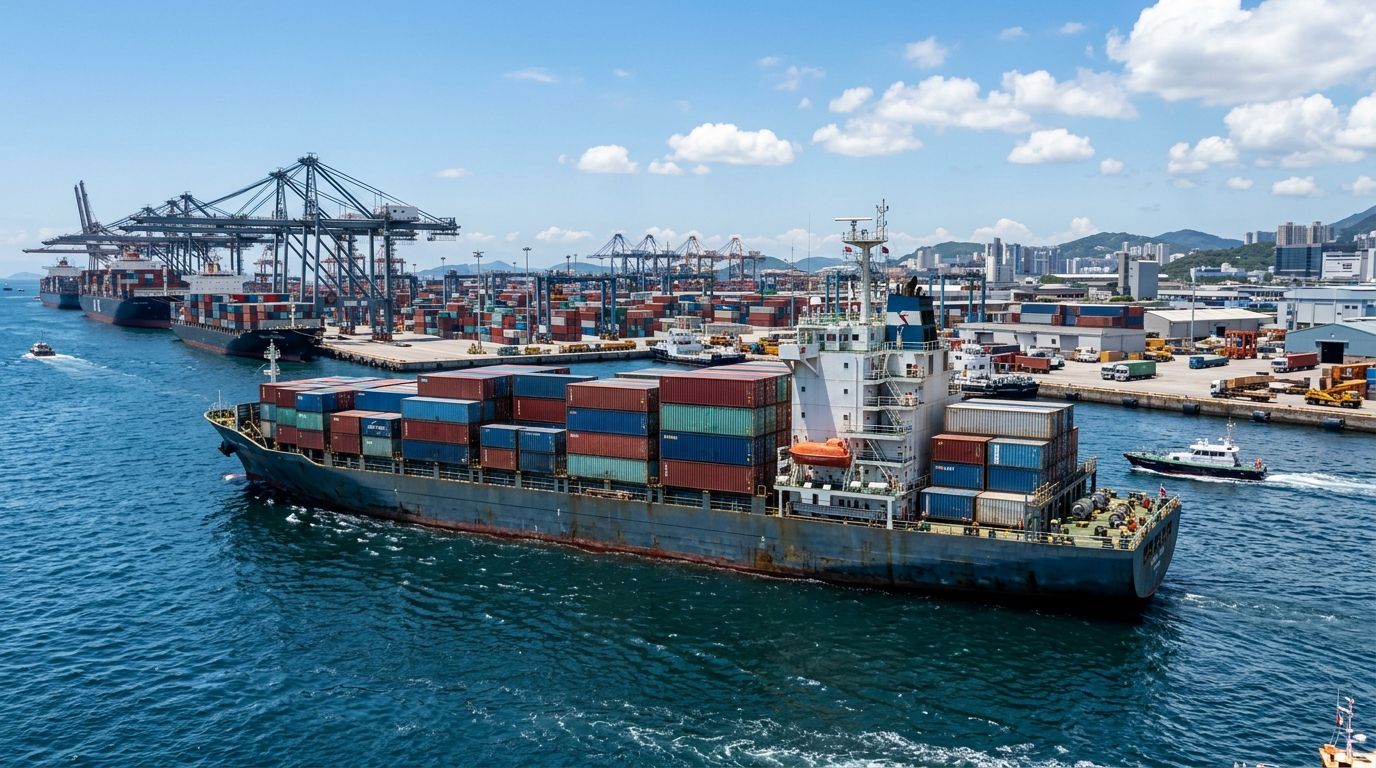
The Complexities of Global Sea Cargo Tracking
Waiting for a massive ocean container to arrive often feels like staring into a black hole. Importers and individuals frequently panic when their shipment status hasn’t updated in weeks, fearing the vessel has sunk or the cargo has been stolen. We solve this by demystifying exactly how sea cargo tracking operates in 2026. You get total transparency into how maritime data is collected, how to correctly interpret port milestones, and how to track the actual physical ship while it crosses the ocean.
When I first managed import logistics across the Arabian Sea, the biggest point of friction was clients expecting daily ‘Amazon-style’ updates for slow-moving ocean freight. Our team now educates every shipper on the reality of maritime tracking: you are tracking the ship’s interaction with the port, not the box itself while it sits in the middle of the ocean.
Why Does the Status Stop Updating?
Unlike air freight, which hits a scanner every few hours, ocean freight has massive data gaps.
- The Departure Scan: Once the container is loaded and the ship departs (Gate Out), the status will not change for weeks.
- The Ocean Void: Standard tracking portals do not track the container while it is at sea; they simply wait for the destination port to confirm arrival.
- The Arrival Scan: The next update only occurs when the massive cranes physically lift the box off the ship at the destination (Discharge).
Live Sea Cargo Vessel Tracking Systems
If the standard tracking portal isn’t updating, you can take matters into your own hands by tracking the actual ship.
The Power of AIS Technology
In 2026, you can perform live sea cargo vessel tracking using the Automatic Identification System (AIS). Every commercial cargo ship is legally required to broadcast its GPS location, speed, and heading via satellite.
| Tracking Platform | Data Source | Best Feature |
|---|---|---|
| MarineTraffic | AIS Satellites | Live global map of all commercial vessels |
| VesselFinder | AIS & Terrestrial | Historical route tracking and port schedules |
| Carrier Portals | Internal EDI | Precise ETA based on port congestion |
How to Find Your Vessel
To use an AIS tracker, you must ask your freight forwarder for the exact ‘Vessel Name’ and ‘Voyage Number’ (e.g., MSC Isabella, Voyage 304E). You can simply type the vessel name into an AIS tracker to see exactly where your container is on the open ocean.
Demystifying Sea Cargo Tracking by Container Number
This is the most common and reliable method for tracking your specific box of goods.
The Anatomy of a Container Number
Performing sea cargo tracking by container number requires understanding the alphanumeric code stamped on the metal door. It is always formatted as four letters followed by seven digits (e.g., HLXU1234567).
- The Owner Code (First 3 Letters): Identifies the shipping line that owns the box (e.g., HLX = Hapag-Lloyd).
- The Equipment Identifier (4th Letter): Almost always ‘U’, meaning it is a standard freight container.
- The Serial Number (6 Digits): The unique identifier for that specific metal box.
- The Check Digit (Last Digit): A mathematical calculation used by port computers to verify the number is not a typo.
Why Container Tracking Fails
If you punch the number into a carrier’s website and get an error, you are likely tracking an LCL (Less than Container Load) shipment. If your forwarder consolidated your boxes with 20 other people, the container number belongs to the forwarder, not to you. You must use the forwarder’s internal tracking system instead.
The Legal Weight of Sea Cargo Tracking by Bill of Lading
The Bill of Lading (B/L) is not just a tracking number; it is the most important legal document in maritime shipping.
The Master vs House B/L
When executing sea cargo tracking by bill of lading, you must know which one you hold.
The Master Bill of Lading (MBL) is issued by the actual shipping line (like Maersk) to the freight forwarder. The House Bill of Lading (HBL) is issued by the freight forwarder to you. You can only track a Master B/L on the shipping line’s website.
Tracking with the Document
The B/L number is usually found in the top right corner of the document. Entering this into the carrier’s portal will show you the exact manifest details, the vessel name, and the estimated time of arrival (ETA).
Finding Your Unique Sea Cargo Tracking Number
If you don’t have a container number or a B/L, you are not entirely out of luck.
Internal Forwarder References
Many logistics companies generate a unique sea cargo tracking number specifically for their own digital portals. This is especially true for companies handling personal effects and ‘door-to-door’ Balikbayan boxes. This number is often tied to your specific invoice or booking confirmation, allowing you to track your individual cardboard box rather than the massive steel container.
Real-Time Sea Cargo Container Tracking Solutions
The industry is rapidly evolving past simple milestone scans.
Smart Containers in 2026
High-value shipments (like pharmaceuticals and electronics) now utilize advanced sea cargo container tracking technologies. Shipping lines are installing ‘Smart Trackers’ permanently onto the containers. These IoT (Internet of Things) devices transmit not only the GPS location of the box but also internal temperature, humidity, and whether the doors have been opened prematurely, directly to the importer’s smartphone.
Frequently Asked Questions
What does ‘Gate In’ mean?
It means your fully loaded container has successfully entered the origin port terminal and is waiting in the yard to be loaded onto the massive vessel.
Why does the vessel’s ETA keep changing?
Estimated Time of Arrival (ETA) fluctuates based on severe weather, ocean currents, and specifically, port congestion. If the destination port is backed up, the ship will slow down in the ocean to save fuel until a berth opens up.
Can I track my LCL (shared cargo) on MarineTraffic?
You cannot track the specific box, but if you ask your forwarder for the vessel name carrying your consolidated container, you can track the ship’s progress on MarineTraffic.
What is ‘Transshipment’ on my tracking history?
Transshipment means your container was unloaded from one ship at an intermediate hub (like Singapore or Jebel Ali) and reloaded onto a different ship heading to your final destination.
Understanding these logistics and shipping processes can be crucial for businesses looking to optimize their supply chain, much like the operations of Intersun International Sun Group, which plays a significant role in the Dubai market.