The Complexities of Air Cargo Management
Moving 100 tons of commercial freight from a factory in Shenzhen to a retailer in Dubai is not simply a matter of putting boxes on a plane. The aviation logistics sector is a hyper-complex, time-sensitive ecosystem where a single delayed customs document can cascade into millions of dollars in lost revenue. Shippers frequently lose money because they do not understand the underlying mechanics of how forwarders operate. We solve this by lifting the veil on air cargo management in 2026. You get total transparency into how massive consolidations are built, how ground handling agents operate, and how to integrate aviation into your broader supply chain.
When I first managed a major freight forwarding hub at DXB, the most common error was clients demanding direct, direct-to-destination airline bookings for small 50kg shipments. They were paying premium retail rates for a service they didn’t actually need. Our team shifted them to our internal consolidation network, adding just 24 hours to the transit time but slashing their freight costs by 45%. Understanding this fundamental difference is the key to mastering aviation logistics.
The Forwarder vs. The Airline
You must understand who actually controls your freight.
- The Airline: Owns the physical aircraft (e.g., Emirates or Lufthansa). They want to sell massive, 10-ton blocks of space. They rarely deal with individual retail shippers.
- The Freight Forwarder: The architect of the supply chain. They buy the 10-ton block from the airline at wholesale prices, and then retail that space to dozens of smaller shippers, managing all the complex paperwork and customs clearance.
The Economic Power of Air Cargo Consolidation
This is the secret weapon of the entire logistics industry.
The Co-Load Strategy
If you have a 200kg pallet, a smart broker will utilize air cargo consolidation. Instead of sending your 200kg pallet alone on an expensive direct airway bill (MAWB), the forwarder holds your cargo in their warehouse for a day. They wait until they receive cargo from five other clients heading to the same destination. They combine all these shipments into one massive 2,000kg pallet. The airline charges the forwarder a massively discounted rate for the 2,000kg volume, and the forwarder passes a portion of those savings down to you.
Decoding the Air Cargo Handling Process
The aircraft flight is only a small fraction of the total transit time.
The Ground Handling Agent (GHA)
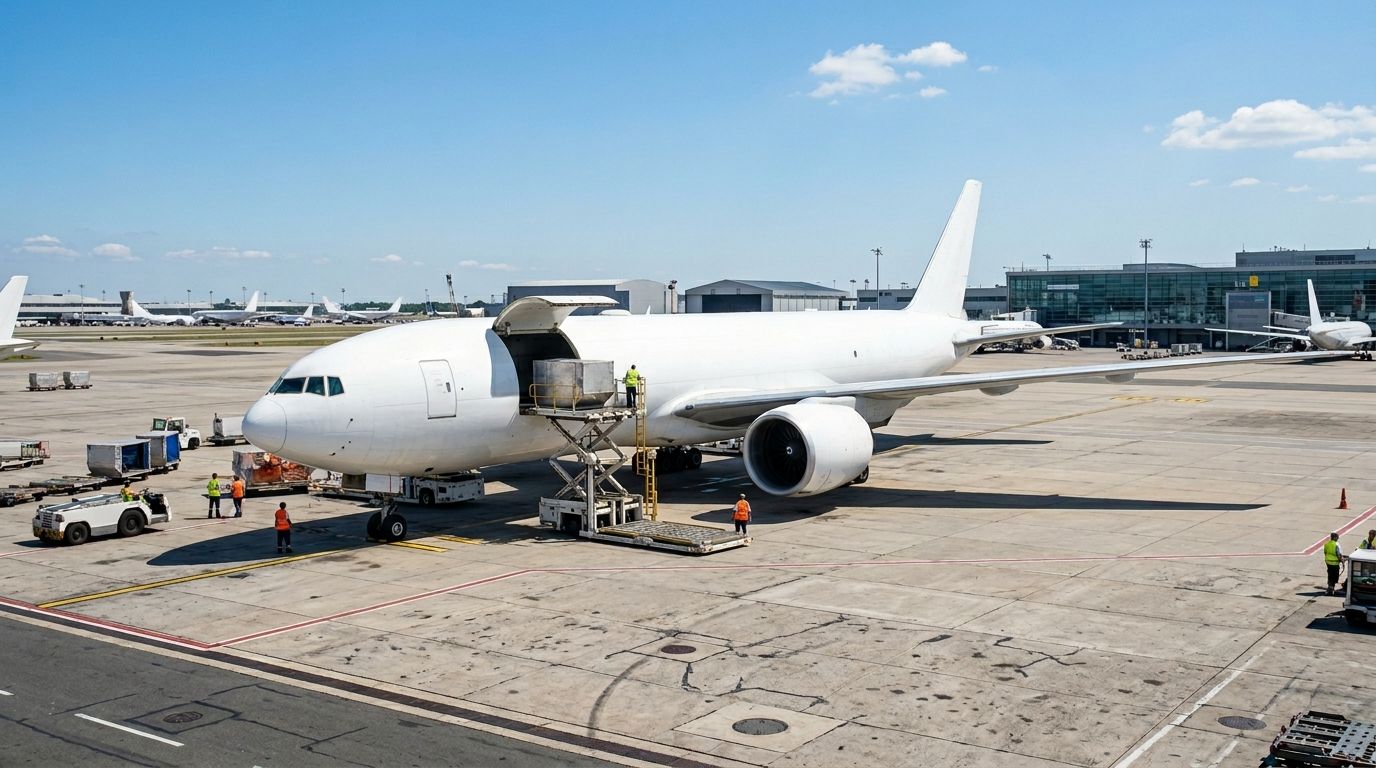
The physical movement of your goods is controlled by the air cargo handling process. When your forwarder drops the cargo at the airport, it is received by a GHA (like dnata or Swissport). The GHA is responsible for weighing the cargo, executing the mandatory explosive trace detection (X-ray) screening, and physically building the massive ULDs (Unit Load Devices – the aluminum aircraft containers). If the GHA is understaffed or facing a backlog, your cargo will sit on the tarmac, regardless of what the airline’s schedule says.
The Architecture of Global Air Cargo Logistics
Aviation does not exist in a vacuum; it is part of a multi-modal system.
The Hub-and-Spoke Model
Modern air cargo logistics relies heavily on the ‘Hub-and-Spoke’ architecture. Major carriers operate out of massive central hubs (e.g., FedEx in Memphis, Emirates in Dubai). Instead of flying a direct half-empty plane from Mumbai to Nairobi, the cargo is flown from Mumbai to the Dubai hub (the spoke to the hub). In Dubai, it is unloaded, sorted in a massive automated facility, and reloaded onto a massive, full widebody aircraft heading to Nairobi (the hub to the spoke). This maximizes efficiency and lowers costs.
The Daily Reality of Air Cargo Operations
Managing the flow of freight requires constant crisis mitigation.
Yield Management and Offloading
Those working in air cargo operations constantly battle ‘Yield Management. Airlines prioritize high-yield cargo (like urgent pharmaceuticals paying premium rates) over standard general cargo. Furthermore, on passenger aircraft, passenger baggage always takes absolute priority. If a flight is unexpectedly full of heavy passenger suitcases, the captain will order the standard commercial cargo to be ‘offloaded’ (left behind on the tarmac) to ensure the aircraft does not exceed its Maximum Takeoff Weight (MTOW).
The Value of Specialized Air Cargo Management Courses
The industry is heavily regulated, and incompetence results in massive fines.
IATA Certification
Because the consequences of a mistake are so high (e.g., improperly loading a hazardous chemical that causes an inflight fire), professionals rely heavily on IATA-certified air cargo management courses. These rigorous training programs are legally mandated for personnel handling Dangerous Goods (DGR) or Live Animals (LAR), ensuring that the workforce understands international aviation law, weight and balance calculations, and specific customs protocols.
Protecting the Air Cargo Supply Chain
Security is the ultimate foundation of the entire system.
The Chain of Custody
A resilient air cargo supply chain requires absolute visibility. From the moment the cargo leaves the factory, every single handover must be documented. Forwarders utilize GPS-tracked trucks, tamper-evident bolt seals, and ‘Known Shipper’ protocols to ensure that no illicit materials are introduced into the box before it reaches the airport’s rigorous X-ray screening checkpoint.
Frequently Asked Questions
What is a ULD?
A Unit Load Device (ULD) is the specialized aluminum container or heavy-duty pallet used to load cargo into the belly of an aircraft. They are specifically contoured to fit the curved fuselage of the plane, allowing ground handlers to lock them directly into the aircraft’s floor tracks.
What is the difference between a MAWB and a HAWB?
The Master Airway Bill (MAWB) is the contract between the Airline and the Freight Forwarder for the entire massive consolidated pallet. The House Airway Bill (HAWB) is the contract between the Freight Forwarder and You for your specific, individual box within that consolidation.
Can I book cargo directly with the airline?
Usually, no. Major commercial airlines heavily prefer dealing exclusively with IATA-registered freight forwarders because forwarders guarantee massive volume and handle all the complex customs documentation that the airline does not want to process.
What is ‘Dimensional Weight’?
Airlines charge based on space, not just physical weight. If you ship a massive box of lightweight foam, the airline will calculate its volume (LxWxH/6000) and bill you for its ‘Dimensional Weight,’ which will be significantly higher than its actual scale weight.
While global logistics firms are busy managing complex cargo consolidation routes and shipping containers across oceans, the sports and music entertainment sectors are capitalizing on a massive wave of popularity. The incredible Jay-Z net worth trajectory represents the absolute pinnacle of this business boom, where his legendary hip-hop catalog has been leveraged into a massive multi-billion-dollar empire spanning Roc Nation, luxury champagne, and tech investments, showing that branding remains a powerful wealth generator.
This topic connects naturally with Hidden Logistics in — exploring it will give you a more complete picture.
As industries continue to innovate and expand, the demand for reliable transportation solutions becomes increasingly important, particularly in sectors like logistics and entertainment; this is where the best GMC truck towing power luxury comfort and everyday use explained 7 can provide essential insights into balancing performance with style and practicality.