The Cellar Builder’s Warning: How to Choose a Moving Company for Fine Wine
Listen to me. I build high-end, climate-controlled wine cellars for the elite of Emirates Hills and Jumeirah Golf Estates. I’ve spent my career creating perfect 12-degree environments for multi-million dirham collections. When a client tells me they are going to hire a “luxury” moving company to relocate their 500-bottle cellar, I ask them one question: “Do they have a continuous cold-chain manifest?” If they look at me blankly, I tell the client to cancel the move. Fine wine is a living, breathing investment. If you don’t choose a moving company for fine wine that understands thermal inertia and vibration damping, you are just paying someone to ruin your assets.
Last year, a collector moved from a villa in Al Barari to a penthouse in the Marina. He hired a mover who claimed to have a “refrigerated truck.” The truck arrived, but the refrigeration unit had been turned off to save fuel during the drive across town. By the time the bottles were unloaded in the Marina, the internal temperature of the wine had spiked from 12 degrees to 35 degrees. That thermal shock caused the wine to expand, pushing the corks and allowing oxygen into his vintage 1982 Bordeaux. The entire collection was ruined in forty-five minutes. Total financial and oenological disaster.
You cannot trust a standard logistics company. Let me show you the paranoid vetting process I use for fine wine relocation.
The Cold-Chain Audit
If the temperature breaks for five minutes, the investment value is compromised.
The Reefer Truck Verification
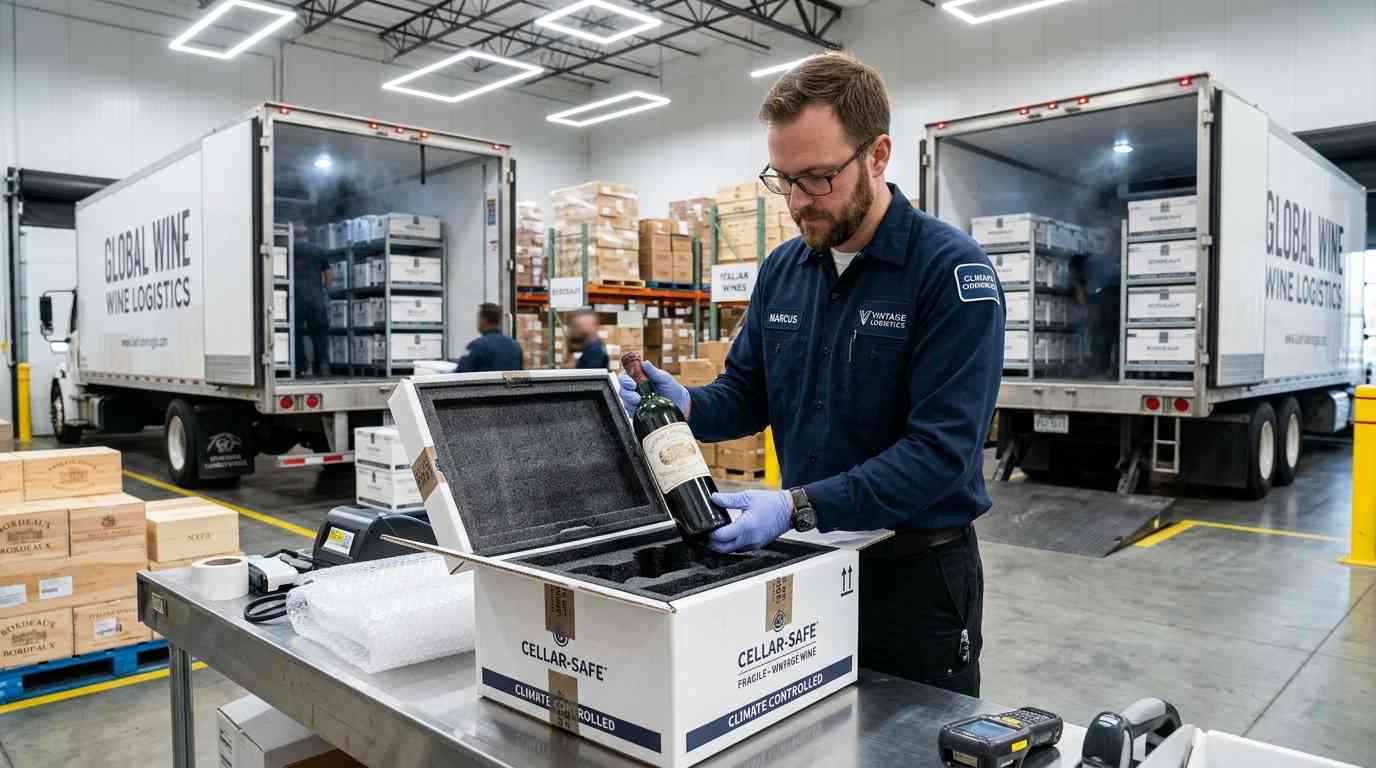
A “refrigerated truck” isn’t enough. You must demand a climate-controlled “Reefer” truck that can maintain a constant, pre-set temperature of 12 to 14 degrees Celsius. But here is the secret: you must verify that the truck has been pre-cooled for at least two hours before it arrives at your house. If they open the back of the truck and it feels like the Dubai summer air inside, do not let them load a single bottle. The wine must move from a 12-degree cellar into a 12-degree truck without ever experiencing a temperature spike.
The Vibration and Light Protocol
Heat kills wine fast; vibration and UV light kill it slowly and surely.
The Kinetic Damping Requirement
Standard moving trucks have leaf-spring suspension that is designed for heavy furniture, not delicate liquids. A professional wine mover uses trucks with air-ride suspension to dampen the kinetic energy of the road. Furthermore, the bottles must be packed in specialized polystyrene or foam-lined wine shippers that provide both thermal insulation and shock absorption. If they try to pack your Petrus in a cardboard box with some bubble wrap, they are amateurs. Stop the move.
If you have a serious collection and need a logistics team that treats every bottle like a fragile masterpiece, check out our Services and specialty wine logistics division. We are the best movers and packers in UAE because my team understands that a 50,000 Dirham bottle requires a 50,000 Dirham level of care.
The Insurance and Valuation Reality
Don’t assume your household insurance covers your cellar.
The Perishable Goods Clause
Most standard moving insurance policies explicitly exclude “perishable goods,” which includes wine. If the truck’s refrigeration unit fails and your wine is cooked, the mover’s basic insurance will pay you exactly zero dirhams. You must demand a specialized “Transit Wine Insurance” policy that covers spoilage due to mechanical failure of the climate control system. This requires a full, itemized inventory with current market valuations (from sites like Liv-ex) before the move starts.
Essential Fine Wine Mover Checklist
| Crucial Vetting Step | Why It Saves Your Collection |
|---|---|
| Demand Pre-Cooled Reefer Trucks | Ensures a continuous 12-14 degree environment from door to door. |
| Verify Air-Ride Suspension | Prevents kinetic vibration from disturbing sediment and causing “bottle shock.” |
| Insulated Polystyrene Shippers | Provides a final layer of thermal and physical protection for high-value bottles. |
| Specialized Wine Insurance | Standard policies do not cover “spoilage” or “cooking” due to heat exposure. |
| White Glove Handling | Prevents UV light exposure and rough handling that can damage delicate labels and foil. |
Frequently Asked Questions
Should I move my wine fridge full?
No. Absolutely never. A wine fridge (like a EuroCave) is not structurally designed to carry the weight of 200 bottles of wine while being tilted and moved. The internal shelves will collapse, and the frame will warp. You must empty the fridge, pack the bottles in insulated shippers, and move the fridge empty.
How long should I wait to drink the wine after moving?
This is critical. Even with the best movers, the wine will experience “travel sickness.” The motion of the truck disturbs the molecular balance of the liquid. You must place the bottles in your new cellar and let them rest completely undisturbed for at least 30 days before pulling a cork. If you open a bottle on night one, it will taste flat and muted.
Can I move my wine in my personal car?
Only if you are moving a very small number of bottles (less than 12) and you can keep the car AC at a freezing cold temperature for the entire duration. Even then, the vibration of a car is much worse than an air-ride truck. For anything of value, use the pros.
Is humidity important during the move?
During a short local move (under 4 hours), the humidity inside the bottle is protected by the cork. However, for international sea freight, the container must be humidity-controlled (around 70%) to prevent the corks from drying out and shrinking, which allows oxygen to enter and ruin the wine.
How do I value my collection for insurance?
You must provide a detailed spreadsheet with the vintage, producer, and cuvée for every bottle. Use a global wine index like Wine-Searcher (Pro version) or Liv-ex to find the current ‘low’ and ‘high’ market values. Insurance will usually cover the average replacement cost.
As you settle into your new home, it’s essential to consider the best educational options for your children. The Finnish approach shaping early learning in Dubai offers a nurturing environment that can greatly benefit their development during this transition.