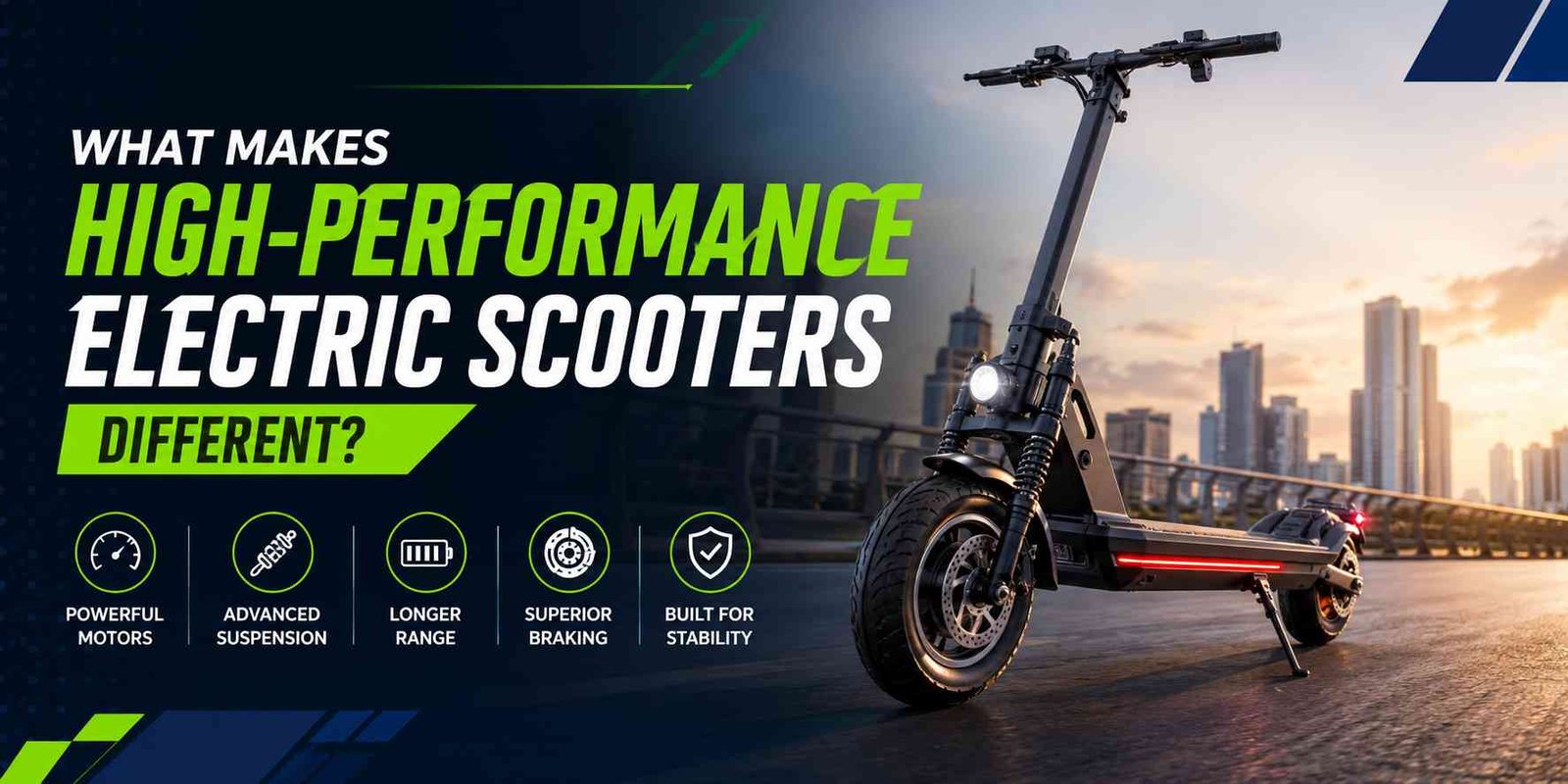
High-performance electric scooters are designed for riders who want more than basic point-to-point transportation. The biggest differences usually appear in motor output, acceleration, stability, suspension, braking, battery capacity and practical riding range.
Unlike lightweight commuter models, performance-focused scooters are generally built around stronger drivetrains and larger batteries. These components work together to provide stronger acceleration, better hill performance and greater capability across different riding conditions.
Why Motor Power Matters on a High-Performance Scooter
Motor power is one of the first specifications buyers notice, but wattage alone does not determine how a scooter will perform. Motor configuration, controller output, battery voltage, rider weight and terrain all influence the final riding experience.
A single-motor scooter sends its drive through one wheel, while a dual-motor design can distribute propulsion across both wheels. This can be particularly useful when starting on an incline, riding over loose surfaces or maintaining acceleration when conditions become demanding.
For example, the GT4 is listed with two 1200W motors, giving it a combined rated motor output of 2400W. Its product specifications also list a 52V 18.2Ah battery and a maximum claimed range of up to 80 km under specified conditions.
For buyers specifically comparing dual-motor electric scooters, the important point is not simply having two motors. The entire electrical and mechanical system needs to be considered together, including the battery, controller, drivetrain and cooling requirements.
Stability Is Just as Important as Speed
More power is useful only when the rest of the scooter can handle it. High-performance models therefore tend to use larger frames, wider decks, stronger suspension systems and larger pneumatic tires than lightweight commuter scooters.
Suspension plays an especially important role when a scooter is used on uneven roads or off-road surfaces. Front and rear suspension can help absorb impacts and keep the tires in contact with the riding surface, improving comfort and control.
The GT4, for instance, is specified with dual swingarm suspension. Its product information also describes an integrated forged-aluminum frame and 12-inch pneumatic tires, features aimed at supporting a more substantial off-road design.
Braking is another essential part of the equation. A scooter capable of higher acceleration and speed needs a braking system appropriate for its weight and performance. Riders should consider brake type, tire condition, suspension setup and overall chassis design rather than judging a scooter purely by its motor rating.
Battery Size Determines More Than Just Range
High-output motors require substantial electrical energy, which is why performance scooters commonly use larger battery packs. Battery capacity is better understood in watt-hours because voltage and amp-hours together indicate how much energy the battery can store.
The GT4’s listed 52V 18.2Ah battery works out to roughly 946Wh of nominal energy capacity. Its manufacturer-listed maximum range is up to 80 km, but that figure should not be interpreted as a guaranteed distance for every rider.
Real-world range can vary considerably depending on rider weight, speed, terrain, temperature, riding mode, tire pressure and how frequently the scooter accelerates. Manufacturer range figures are generally achieved under controlled or favourable conditions.
That is why buyers comparing scooters should look beyond the headline range number. A larger battery can provide greater energy reserves, but riding style and environmental conditions still determine how much distance is possible between charges.
How High-Performance Scooters Compare With Everyday Models
A typical commuter scooter prioritizes portability, moderate speed and simple urban transportation. A performance scooter makes different compromises, often accepting greater weight and size in exchange for stronger motors, larger batteries and more substantial hardware.
The difference becomes clearer when comparing specifications. CyberCart’s GT1, for example, is listed with an 800W single motor, a 48V 10Ah battery and a claimed range of up to 45 km. The GT4 moves to a dual 1200W motor configuration and a 52V 18.2Ah battery.
These specifications demonstrate why performance scooters are usually heavier than entry-level commuter models. Larger motors, battery packs, suspension components, tires and frames all add material and weight.
Range Should Be Evaluated Realistically
Claimed range is useful for comparing products, but it should always be treated as a reference point rather than a promise. Two riders using the same scooter can achieve very different results because their riding conditions may be completely different.
Someone travelling at moderate speeds on relatively flat terrain may achieve considerably more distance than a rider repeatedly accelerating, climbing hills or riding at higher speeds. Carrying additional weight can also increase energy consumption.
This same principle applies when comparing other forms of electric mobility. Buyers researching electric bicycle price will often find that battery capacity, motor output, frame design and component quality affect the overall cost and capability of an e-bike.
Performance Is Part of a Wider Mobility Shift
Electric mobility is also influencing how people think about transportation, relocation and everyday travel across the UAE. As consumers explore more flexible ways to move people and belongings, choosing a reliable moving company in the UAE can be an important part of planning a smooth relocation alongside other transportation needs.
For commuters considering electric scooter UK options, practical factors such as local regulations, permitted riding areas, charging access, weather and storage can be just as important as specifications.
Electric bicycles are another growing option for people looking for efficient personal transportation. Those interested in electric bicycles online can compare different frame styles, battery capacities and motor configurations depending on their intended use.
Other forms of personal electric transportation have developed alongside scooters and e-bikes. Consumers researching best hoverboard UK options, for example, are looking at a different type of compact electric vehicle designed around self-balancing technology.
These products all form part of the wider eco-mobility conversation, although each vehicle serves a different purpose. Choosing between them ultimately depends on distance, terrain, portability, local rules and personal transportation requirements.
What Buyers Should Check Before Choosing a Performance Scooter
Motor power and battery capacity are important, but they should never be the only criteria. A well-rounded evaluation should consider the complete scooter and how its specifications match the rider’s intended use.
- Motor configuration: Check whether the scooter uses a single or dual-motor drivetrain and understand how the system is intended to be operated.
- Battery capacity: Compare watt-hours rather than relying only on amp-hours when evaluating energy storage.
- Suspension: Front and rear suspension can be valuable for uneven roads and off-road surfaces.
- Tires: Larger pneumatic tires can provide useful cushioning and traction characteristics on suitable terrain.
- Brakes: Make sure the braking hardware is appropriate for the scooter’s weight and performance level.
- Weight: A larger performance scooter may be substantially less convenient to carry or store.
- Range: Treat advertised range as a benchmark and account for real-world riding conditions.
- Legal requirements: Always check the rules governing electric scooters in the area where the vehicle will be used.
The Real Difference Between Standard and High-Performance Scooters
The defining characteristic of a high-performance electric scooter is not one specification. It is the way multiple components are engineered to work together.
Higher motor output can provide stronger acceleration, while a larger battery supplies the energy needed to support that drivetrain. Suspension, tires, brakes and chassis construction then become increasingly important as performance increases.
That is why comparing scooters only by top speed or motor wattage can lead to an incomplete decision. The better approach is to evaluate power, stability, battery capacity, range, braking, suspension, weight and intended riding conditions as one complete package.
For riders who need stronger performance for hills, rougher terrain or longer journeys, a properly equipped high-performance scooter can offer capabilities that a lightweight commuter model cannot match. The right choice, however, is ultimately the one whose specifications and operating characteristics fit the rider’s actual needs.