The Hidden Risks of Cross-Border Auto Transport
Are you trying to relocate to Europe or ship your luxury sports car back to your home country, only to be terrified by horror stories of vehicles arriving scratched, dented, or impounded by customs? Many expatriates experience this exact nightmare. Assuming that shipping a two-ton vehicle across the ocean is as simple as mailing a large parcel is a critical mistake. If you hire a cheap, unverified freight broker who forces your car into a poorly secured container, a single rough storm at sea can cause your vehicle to break loose and smash into the steel walls. The financial devastation of opening a container to find your prized car completely totaled is completely avoidable.
We solve this by giving you the ultimate 2026 blueprint for flawless international auto logistics. You can expect a complete, unfiltered breakdown of exactly how to ship a car overseas safely, the true hidden factors that dictate international car shipping cost, and how to verify if a transport company actually owns their own ships or is just a middleman broker.
How to Ship a Car Overseas
The Three Primary Transport Methods
You cannot simply drive your car to a port and hand over the keys. You must explicitly choose how your vehicle will be physically secured for the ocean transit.
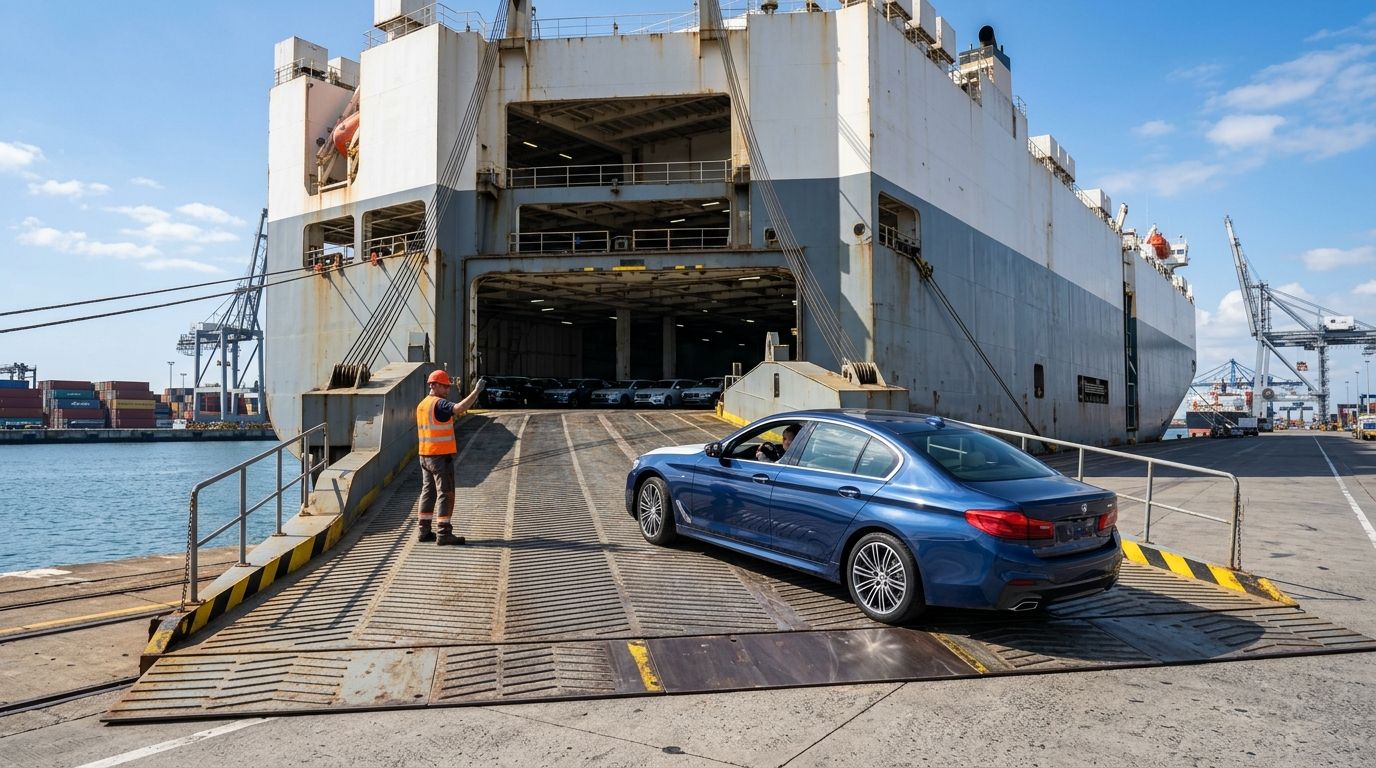
- RoRo (Roll-on/Roll-off): This is the most common and cost-effective method. Your car is driven up a massive ramp into the enclosed deck of a specialized auto-carrier ship, much like a giant floating parking garage. The vehicle is securely chained to the floor.
- Dedicated Container (FCL): You rent an entire 20-foot steel shipping container exclusively for your vehicle. The car is driven inside, the wheels are blocked with wooden chocks, and industrial straps tie the chassis to the container floor. This is ideal for high-value luxury or classic cars.
- Consolidated Container (LCL): Your car shares a 40-foot container with another vehicle or household goods. This is cheaper than a dedicated container but takes much longer because the forwarder must wait to find another customer to share the space.
How to Ship a Car to Another Country
The Legal Documentation Gauntlet
The physical transportation of the vehicle is actually the easiest part. Navigating the export and import legalities is where most shipments fail.
The Export Clearance Process
Before your car is even allowed to enter the origin port in Dubai or Los Angeles, you must prove absolute legal ownership.
- Clear Title Requirement: You must present the original, unencumbered vehicle title. If you have an active bank loan on the car, you CANNOT legally export it without a notarized letter of permission from the lienholder.
- Export Certificate: In the UAE, you must deregister the vehicle with the RTA (Roads and Transport Authority) and obtain a specific blue “Export Certificate” before the shipping agent can process the customs paperwork.
- The “No Items” Rule: For RoRo shipping, you are legally prohibited from packing personal belongings inside the trunk or cabin of the car. If customs inspectors find a suitcase in the backseat, they will immediately halt the export process and fine you.
International Car Shipping Cost
The Illusion of the “Flat Rate”
When you ask a broker for a quote, they often give you an artificially low base ocean freight rate. This is a common trap to secure your deposit.
Decoding the Final Invoice
The true international car shipping cost is a combination of massive origin and destination fees.
| Cost Component | Description | Estimated Impact |
|---|---|---|
| Base Ocean Freight | The cost of the actual space on the ship (RoRo vs Container). | 40% of Total Invoice |
| Origin Terminal Handling (OTHC) | Port fees for receiving, inspecting, and loading the car. | 15% of Total Invoice |
| Destination Terminal Handling (DTHC) | Fees charged by the receiving port to unload the vehicle. | 20% of Total Invoice |
| Customs Clearance & Duties | Taxes assessed by the destination government based on car value. | 25%+ (Highly Variable) |
“Never accept a quote that says ‘Port-to-Port’ without an itemized breakdown. You must explicitly ask your broker what the estimated DTHC (Destination Terminal Handling Charges) will be, as predatory agents often hide massive fees at the arrival port.”
International Car Shipping Rates
What Drives the Price Fluctuations?
In 2026, international car shipping rates are highly dynamic, fluctuating based on several macro-economic and logistical factors.
The Size Penalty
Ocean freight rates are heavily dictated by the physical dimensions (CBM – Cubic Meters) of your vehicle. Shipping a massive Cadillac Escalade SUV via RoRo will cost significantly more than shipping a compact Honda Civic, simply because the SUV takes up more physical deck space on the ship. If you lift or modify your truck, the increased height can bump your vehicle into a higher, more expensive tariff bracket.
The Destination Route Density
Shipping a car from New York to London (a high-density, incredibly common trade lane) is drastically cheaper than shipping a car from Dubai to a remote port in East Africa. For obscure destinations, the ship must make multiple transshipment stops, driving the rates astronomically high.
International Car Shipping Companies
Brokers vs. Actual Asset-Based Carriers
The biggest mistake consumers make is assuming the company they found on Google actually owns the massive ship their car will sail on.
Spotting the Middleman
There are two types of international car shipping companies you will interact with:
- Freight Forwarders/Brokers: These companies do not own ships. They act as travel agents for your car, negotiating rates with the actual shipping lines and handling the complex customs paperwork for you. A good broker is invaluable, but a bad broker will take your deposit and vanish.
- Asset-Based VOCCs (Vessel Operating Common Carriers): These are the massive global maritime giants (like Wallenius Wilhelmsen or Hoegh Autoliners) that actually own and operate the colossal RoRo vessels. They rarely deal directly with consumers shipping a single personal car; they rely on forwarders to aggregate the bookings.
The Bottom Line on Global Auto Transport
Summary of Key Takeaways
Shipping a vehicle internationally is a massive legal and logistical undertaking that requires strict preparation.
- Always ensure your vehicle title is completely clear of bank liens before attempting to export.
- Choose RoRo for the cheapest standard transport, but demand a dedicated 20ft container if you are shipping a high-value luxury vehicle.
- Never pack personal belongings inside your car if you are using a RoRo service.
Frequently Asked Questions
Can I ship a car that does not run?
Yes, but it is much more expensive. If the car cannot drive up the ramp under its own engine power, it is classified as a “Non-Runner.” The port must use specialized forklift equipment or tow-trucks to drag the car onto the ship, which incurs a massive non-runner surcharge.
How much fuel should be in the car when I ship it?
Strict maritime safety regulations require the gas tank to be less than 1/4 full. If you deliver a car to the port with a full tank of gas, the port authorities will charge you a hazardous materials fee to safely drain the excess fuel before loading.
Do I need to buy marine insurance for my car?
Yes. The basic liability coverage provided by the shipping line (under the Carriage of Goods by Sea Act) is often pennies on the dollar. You must purchase a comprehensive “All-Risk” marine insurance policy that covers the full replacement value of your vehicle.
Will the battery die during the ocean voyage?
It is highly likely. Because modern cars have parasitic power drains (alarms, computers), a 30-day ocean voyage often results in a dead battery. It is standard industry practice for the destination port to use a jump-box to start the car upon arrival.
Readers who enjoyed this post also found value in Shipping from Dubai to Netherlands — a must-read for anyone interested in this subject.
For those considering other shipping routes, an insightful resource can be found in our analytical review of shipping from Sheffield to Sharjah, which offers valuable comparisons and tips for international vehicle transportation.