The Consultant’s Protocol: How to Move Your Massive Safe or Vault Without Killing Anyone
Listen, I’ve spent thirty years securing bank vaults and moving high-value assets for jewelry collectors in Emirates Hills and Palm Jumeirah. When a client tells me they are going to let their “regular movers” move your massive safe, I don’t just worry about the safe; I worry about the structural integrity of the house. A standard fireproof home safe can weigh 200 kilos. A proper high-security jewelry vault can weigh over 1,000 kilos (one metric ton). That is the weight of a small car concentrated into a two-foot square. If you don’t understand the physics of floor loading and center of gravity, you aren’t moving a safe; you’re building a wrecking ball.
Last year, an executive in Jumeirah Islands hired a cheap moving crew to move a 600-kilo gun safe down a flight of marble stairs. The movers didn’t have a motorized stair climber or a specialized heavy-duty dolly. They tried to man-handle it with four guys and some straps. Halfway down, the weight shifted. The safe broke through the marble tread, crushed the foot of one of the laborers, and tumbled down the rest of the stairs, smashing the front door clean off its hinges. The repair bill for the house was higher than the value of the safe. Total logistical disaster.
You cannot treat a ton of steel like a refrigerator. Let me show you the paranoid protocol I use for heavy-metal extraction.
The Floor Loading Mandate
Before the safe moves an inch, we look down, not up.
The Structural Assessment
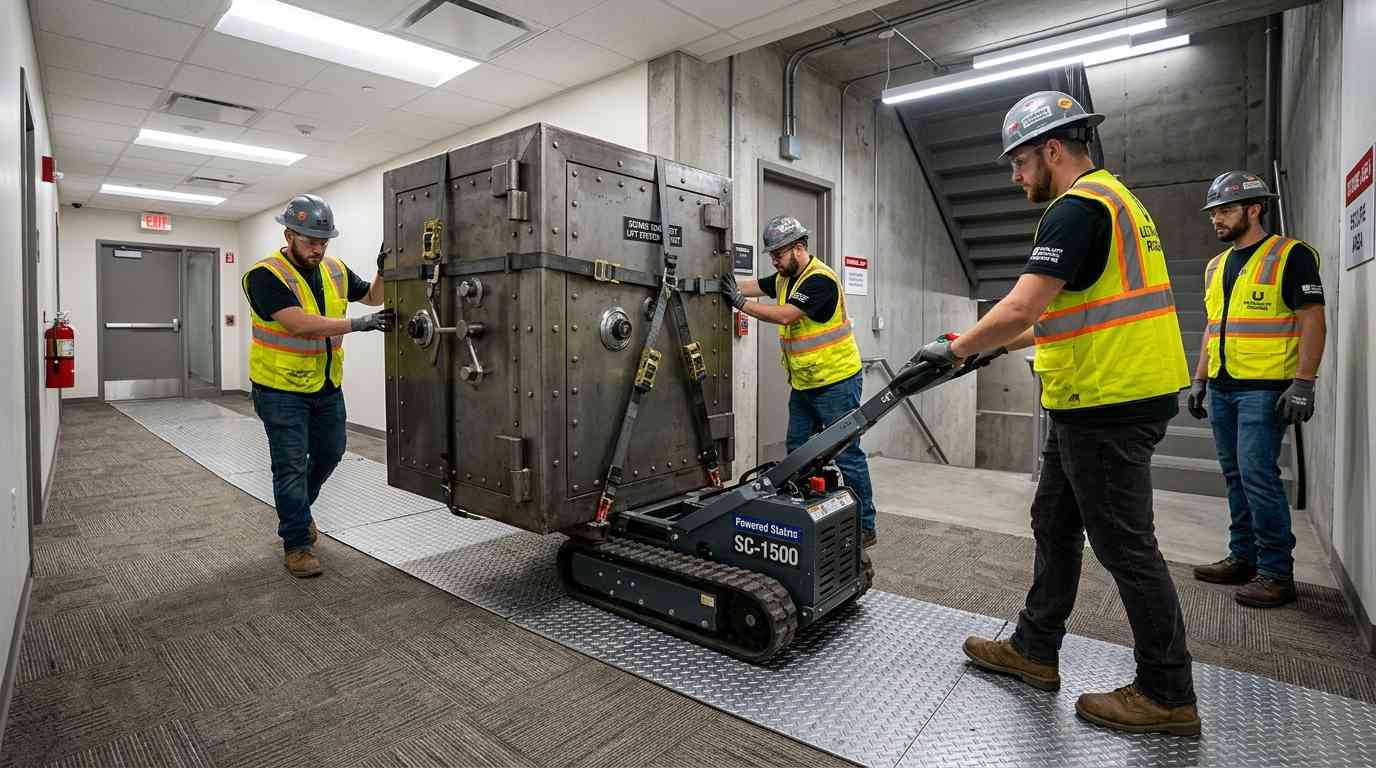
A 500-kilo safe sitting on a 10th-floor apartment floor is a massive point-load. If your building uses post-tensioned concrete slabs, you cannot just drag that safe across the floor. You risk cracking the slab or puncturing the screed. We use heavy-duty steel plates or thick plywood “runways” to spread the weight across the floor joists as we move. If your mover shows up without floor protection plates for a half-ton safe, kick them out. They are about to destroy your floor and potentially your neighbor’s ceiling.
The Vertical Challenge: Stairs vs Elevators
Gravity is your enemy, and it never sleeps.
The Service Elevator Capacity
Most service elevators in Dubai towers have a weight limit of 1,000 to 1,500 kilos. That sounds like enough, right? Wrong. You have to subtract the weight of the moving crew and the equipment. If you put a 1,000-kilo vault and four heavy-set movers into an elevator, you are pushing the safety limit. If the lift sensors detect an over-limit, it will lock between floors. Now you have a ton of steel and four panicked guys stuck in a dark shaft. Always verify the elevator’s actual lifting capacity with the building manager before you load the safe.
If you have a serious security setup and want a team that understands the paranoia of moving heavy steel without cracking your marble, check out our Lifestyle and specialty heavy-lift division. We are the best movers and packers in UAE because my crew uses motorized stair-climbers and hydraulic jacks designed for bank-level security.
The Stealth Requirement
You don’t want the whole world knowing you have a vault.
The Unbranded Move
A high-security safe move should be invisible. You don’t want a truck with “SAFE AND VAULT MOVERS” written on the side parked in your driveway for three hours while your neighbors watch. We use unbranded, enclosed trucks. We wrap the safe in heavy-duty moving blankets and shrink-wrap so it looks like a standard piece of industrial equipment or a large cabinet. Security is about more than just the steel; it’s about the information. If the whole community knows where your vault is located, you’ve already compromised your security.
Essential Heavy-Safe Moving Checklist
| Crucial Protocol | Why It Prevents a Catastrophic Failure |
|---|---|
| Structural Floor Audit | Spreading the weight prevents the safe from cracking the concrete floor slab. |
| Motorized Stair Climbers | Manual labor cannot safely control a 500kg+ mass on a vertical incline. |
| Verify Elevator Capacity | Prevents the lift from locking or the cables from stretching under extreme load. |
| Plywood Runways | Essential for protecting expensive marble and hardwood floors from point-load damage. |
| Unbranded Logistics | Maintains the secrecy of your high-value assets and prevents targeted theft. |
Frequently Asked Questions
Can I move my safe with the contents inside?
No. Absolutely not. Apart from the weight issue, the contents (watches, jewelry, documents) will bounce around during transit and can be damaged. More importantly, if the safe is tilted, the contents can shift and jam the internal locking bolts, making it impossible to open when you arrive at the new house. Empty the safe completely and move the contents in your personal car.
Should I bolt my safe to the floor in the new house?
Yes. A safe that isn’t bolted down is just a very heavy box that a thief can take with them. However, in a rental villa or apartment, you must get the landlord’s permission before drilling 6-inch holes into the concrete floor. Most professional installers use heavy-duty expansion bolts that provide hundreds of kilos of pull-resistance.
Can the movers open my safe if I lose the key?
No. A moving company is not a locksmith. If the safe is locked and you don’t have the code or key, the movers can move the physical box, but they cannot help you get inside. You will need to hire a certified safecracker or a specialized locksmith after the move.
Do I need a special permit to move a safe?
In most residential communities in Dubai, you don’t need a specific ‘safe permit,’ but you do need an NOC (No Objection Certificate) for any heavy equipment delivery. You must inform the building security that you are moving a high-weight item so they can inspect the service elevator and ensure the loading bay is clear.
Will moving insurance cover the contents of the safe?
Never. Moving insurance explicitly excludes cash, jewelry, and high-value documents. Your personal home insurance might cover it, but you must notify your provider that the safe is being relocated. The moving company’s insurance only covers the physical steel box itself.